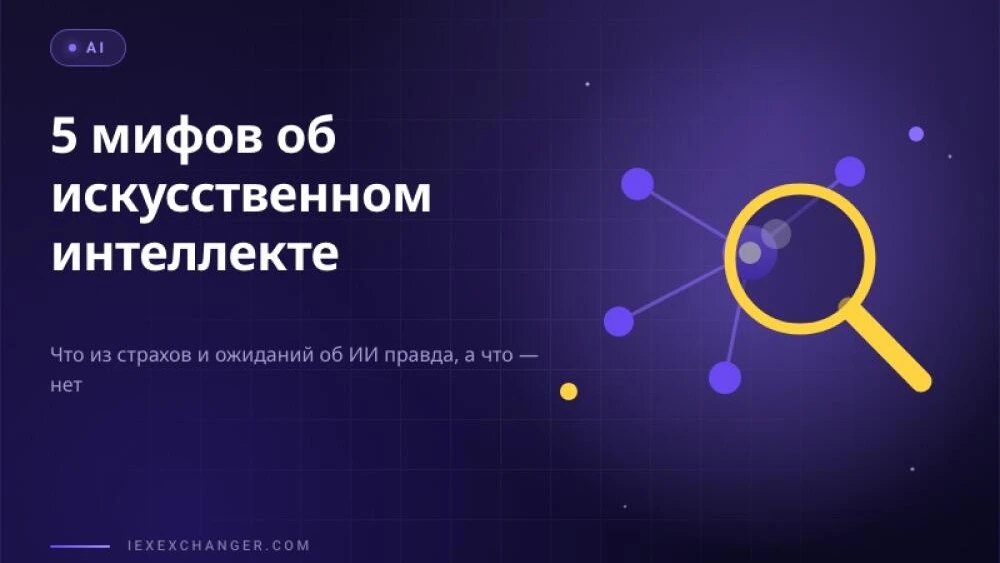
Myths about artificial intelligence get in the way of judging the technology soberly: some expect miracles from AI, others fear it for no reason. By 2026 neural networks have become a working tool, and it matters to tell real capabilities apart from fears and exaggeration. Below are the five most common misconceptions about AI, and how things actually stand.
Myth 1: AI will soon replace people in every profession
The reality is more complicated. AI automates individual tasks well, but it rarely replaces a whole profession.
Take an accountant. A neural network will quickly sort transactions and draft a report — but negotiating with the tax office, assessing risk and making non-standard decisions still falls to a human. More often AI changes not the profession itself but the mix of tasks within it: it takes the routine and leaves the expert part.
Myth 2: artificial intelligence understands the world like a human
It doesn't. Modern AI does not grasp the meaning of what is said — it predicts the most likely continuation of the text based on a huge volume of data.
This matters in practice. A model can answer confidently and fluently without truly understanding the subject — which means its words cannot be treated as an expert opinion. It is a brilliant imitator, not a conscious interlocutor.
Myth 3: AI never makes mistakes and is always objective
This is a dangerous misconception. Neural networks make mistakes, invent facts and inherit bias from the data they were trained on.
The errors even have a name — hallucinations: the model states wrong information in a confident tone. And if the training data was skewed, that skew shows up in the answers. So important decisions should always be double-checked, especially when money is on the line.
Myth 4: AI is a technology of the distant future
AI is already here, and you meet it every day. Online translators, recommendations in apps, banks' anti-fraud systems, search, voice assistants — all of it runs on machine learning.
The crypto industry is no exception: algorithms analyse transactions, flag suspicious activity and help support teams answer customers faster.
Myth 5: using AI at work is complex and expensive
Not any more. Basic AI tools can be set up in a matter of hours, and many of them are affordable even for small teams on a subscription.
It's best to start not with sweeping automation but with one clear task — drafting support replies, for example. Those launching their own crypto exchanger on ready-made platforms like iEXExchanger find it easier to add such tools on top of ready infrastructure, without hiring a separate team.
Conclusion
Most myths about artificial intelligence come from two extremes — inflated expectations and unfounded fears. The reality is calmer: AI is a powerful but limited tool that strengthens a human rather than replacing them. Understanding these limits helps you use the technology with real benefit and without disappointment. And for those who want to apply AI in their own crypto project, it is more convenient to build it on a ready-made platform like iEXExchanger.