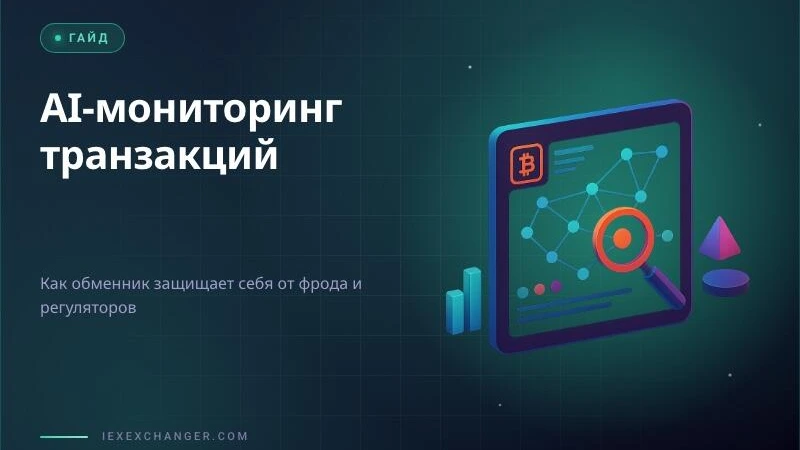
Picture this: a client completes a swap, receives the crypto — then it turns out their wallet is flagged in a money laundering investigation. AI transaction monitoring catches these situations before the funds ever leave your account. Every payment gets a risk score, every address is checked against risk databases — all in real time, without manual intervention.
How it differs from standard AML
Traditional AML means a list of blacklisted addresses and manual reviews on demand. Useful, but slow — and only effective against known threats. AI monitoring works differently: the system learns behavioral patterns, maps relationships between addresses, and detects anomalies even when a specific address hasn't appeared on any official list yet. Think of the difference between a security guard with a printed blacklist and a video analytics system that spots suspicious behavior on its own.
Core capabilities: real-time transaction scoring, on-chain funds tracing, sanctions screening against OFAC, EU, and UN lists, mixer and tumbler detection, graph-based wallet relationship analysis.
What an exchanger actually loses without monitoring
Not in theory — in practice. Four situations that hit exchangers regularly:
- Dirty funds — a client arrives with crypto linked to a darknet marketplace or hack. The exchanger processes it and becomes a link in the chain. Result: asset freeze, law enforcement inquiry.
- Mixer transactions — a payment provider or banking partner spots these in the transaction history and terminates the partnership. Without warning.
- Card fraud — stolen card scheme, chargeback 60 days later. The crypto is long gone. The loss sits entirely with the exchanger.
- Regulatory audit — an inspector asks for AML policy documentation and transaction review logs. There are none. Fine issued; in the worst case, operating authorization revoked.
How the system works in practice
The flow is straightforward. Client initiates a swap → API call to the monitoring service → response with risk score (typically 0–100) and a risk breakdown → exchanger makes a decision.
A high score doesn't mean automatic rejection. A sensible risk logic: under 30 — pass; 30–70 — request supporting documents; above 70 — decline or hold for review. Every operator calibrates these thresholds to their own risk profile.
API response speed matters. At 200–500 ms, the client doesn't even notice the check. At 5 seconds, UX suffers and conversion drops.
What to look for when choosing a service
The market offers dozens of solutions: Chainalysis, Elliptic, Crystal Blockchain, AMLBot, Scorechain — and a few dozen smaller players. Four things to evaluate before choosing:
- Network coverage. Is BTC and ETH enough? Most exchangers also need TRON (USDT-TRC20), TON, Solana, possibly BSC. Ask before signing up.
- Speed and operating mode. Real-time on-chain analysis vs. batch post-analysis — these are two fundamentally different tools.
- Database quality. How often is the risk address data updated? Once a day means yesterday's intel.
- Pricing model. A subscription with request limits, or pay-per-check. At lower volumes, the latter often works out cheaper.
When AI monitoring won't save you
Honestly: no system guarantees anything. Novel fraud schemes work until the database catches up — and there's a lag of hours or days. False positives happen: a legitimate client hits a delay, gets frustrated, leaves.
The final decision always stays with a human. The AI system flags and documents — but responsibility for the call rests with the operator. That's the right setup: the tool assists, it doesn't replace judgment.
Conclusion
AI transaction monitoring isn't about paranoid security theater or ticking a compliance box. It's about documented protection — proof that your exchanger reviewed every transaction and made decisions deliberately. When you face a regulator or a payment partner, that's exactly what counts.
Building an exchanger with a solid operational foundation — from the core engine to compliance tool integrations — is what iEXExchanger is built for.