Anthropic is an American artificial-intelligence company and the creator of the Claude AI model. In just a few years it has gone from a small team that walked out of OpenAI to one of the industry's leading players. This breakdown covers the full history of Anthropic: how and why it appeared, the milestones it passed, what Claude is, how its approach to AI safety works, and where all of this is useful for business.
How Anthropic came to be
The story of Anthropic began in 2021 with a high-profile departure: a group of researchers left OpenAI to found their own company. It was led by a brother and sister — Dario and Daniela Amodei. Dario, previously VP of Research at OpenAI, became the CEO; Daniela became the president.
The reason for leaving was not money, nor ambition for its own sake. The team wanted to build powerful AI, but with a different priority — to put the safety and predictability of models at the centre of all research rather than on its edge. The new company grew out of that difference in views.
Key milestones: a short timeline
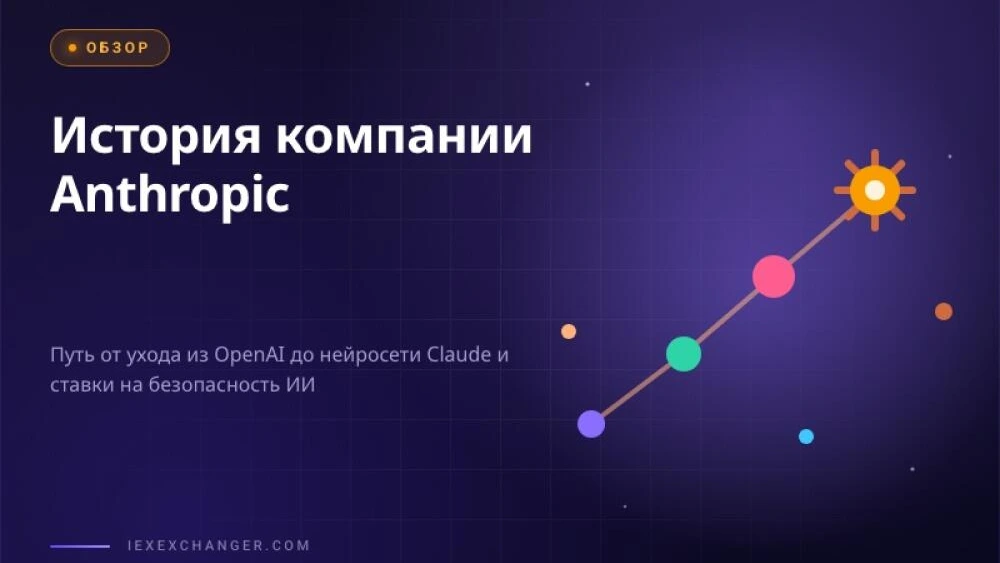
To see the whole picture, it helps to walk through the main stages of the company's development.
- 2021. Anthropic is founded. The company is registered as a public benefit corporation — an organisation legally required to weigh public benefit alongside profit.
- 2022. Anthropic publishes its Constitutional AI research — a method of training a model against a set of written principles. In parallel, work continues on the first version of Claude.
- 2023. Claude becomes publicly available. Access via the API appears, and developers and companies start using the model.
- 2024. The Claude 3 family is released, with three tiers of power — Opus, Sonnet and Haiku.
- 2025-2026. Newer, more capable generations of Claude appear, and Anthropic cements its place among the world's leading AI companies.
The core idea: safe artificial intelligence
In short, the whole of Anthropic is built around one question: how do you make powerful AI safe and predictable? This is not a marketing slogan — it is the foundation of the strategy.
The logic is simple. The more capable a model becomes, the more serious the consequences of its mistakes, and the more it matters that a human understands why it behaves one way and not another. That is why Anthropic invests heavily in interpretability research — attempts to look inside a neural network and understand how it reaches its decisions.
The same principle is built into the company's structure. Public benefit corporation status obliges Anthropic to balance commercial interests with its stated mission. And its responsible scaling policy ties the release of more powerful models to mandatory safety measures: the greater the capability, the stricter the requirements.
Claude: what Anthropic's AI can do
Claude is Anthropic's flagship product — a family of large language models and the AI assistant built on them. It holds conversations, writes and edits text, works through documents, and helps with code and data analysis.
One important detail is the range of models of different power for different tasks. The line-up usually includes lighter, faster models for simple operations and stronger ones for complex work. You choose the level you need and don't overpay for capabilities you won't use. Access is available through a web interface, mobile apps, and an API that lets businesses embed Claude into their own services.
Constitutional AI: how Anthropic trains the model
The company's main technical calling card is an approach called Constitutional AI. The idea is that the model's behaviour is guided by a set of written principles — a kind of "constitution".
Instead of relying only on humans manually labelling every answer, the model learns to check its responses against these principles and correct itself. The goal is the behaviour the company sums up as "helpful, honest, harmless". This approach makes the logic of training more transparent: the rules can be read and discussed rather than guessed at from the model's behaviour.
How Anthropic and Claude help business
For companies, Anthropic is interesting not for its philosophy but for its practical value: Claude takes on the routine work there are never quite enough people for. Customer support, working with text, document review, helping developers — all of it can be partly handed to an assistant.
Crypto projects are no exception. Those launching their own exchanger on ready-made platforms like iEXExchanger can plug AI tools into support and content on top of ready infrastructure, without assembling a development team from scratch.
Limitations: a sober view
However strong Claude is, treating it as a source of absolute truth is a mistake. Every language model has weak spots.
- The model can make mistakes and will sometimes state an inaccuracy with full confidence — this phenomenon is called a "hallucination".
- It does not replace a specialist on legal, tax or financial questions.
- Answers should be checked, especially when money or reputation is involved.
The sensible way to work is simple: AI helps and speeds things up, while the final decision stays with a human.
Conclusion
The history of Anthropic is an example of how a bet on AI safety grew from a niche idea into the foundation of a major company. In just a few years the team went from leaving OpenAI to its own Claude family of models, used by developers and businesses worldwide. The "helpful, honest, harmless" approach is gradually becoming a reference point for the whole industry. For those who want not just to follow this but to launch their own crypto exchanger and put such AI technologies into practice, it is easier to start with a ready-made platform like iEXExchanger.