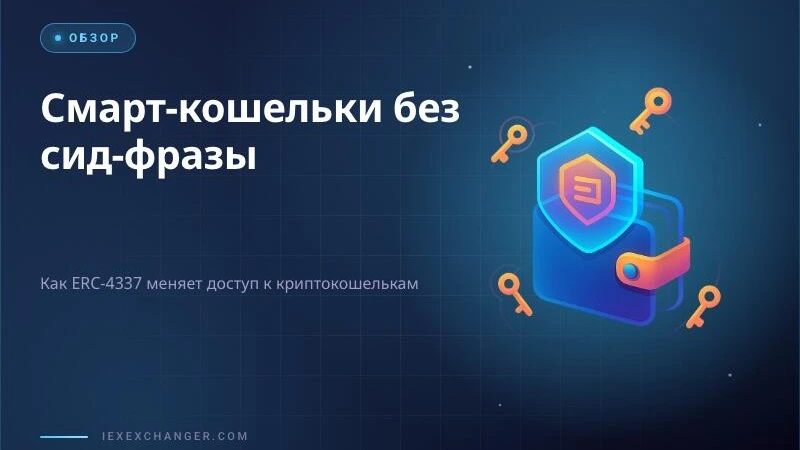
Account abstraction is the reason your crypto wallet is about to stop being one forgotten phrase away from disaster. Forget your email password and you reset it in five minutes. Lose your seed phrase and, until now, that money was gone for good — no support ticket fixes that. ERC-4337 changes the wallet from a bare key pair into a programmable smart contract with its own access rules.
What it actually means, in plain terms
A standard crypto wallet is an EOA — an externally owned account. One private key (or the seed phrase it's derived from) equals full access. Lose the key, and there is no one left to call, because nobody, including you, controls it anymore.
A smart wallet built on ERC-4337 works differently. It's not a key — it's a small program with its own rules: how many signatures a transfer needs, who can approve a recovery, whether there's a daily spending cap. Think of the difference between a plain front-door key and a smart lock where you can add access codes, set time windows, and revoke one person's entry without rekeying the whole door. That's roughly what a smart-contract wallet does with money.
The problem that's quietly costing exchangers customers
Take a real-shaped scenario. A customer — call him Alex — used a mobile wallet for a year and a half. His phone broke, and the seed phrase backup was on a sticky note that didn't survive a move. Result: $3,200 in USDT locked away permanently. No support team on earth can fix that, because crypto is deliberately built so no one can.
It's not a rare edge case — blockchain forensics firms regularly cite lost keys as one of the main reasons a meaningful share of all mined bitcoin is considered gone for good. For an exchanger, that's reputational risk and a stream of support tickets that can't be resolved with anything but sympathy.
How account abstraction actually fixes it
An ERC-4337 wallet adds something a plain EOA never had: configurable recovery. The owner names "guardians" in advance — trusted contacts, a hardware key, a second company wallet, even a KYC provider's service. If the main way in is lost, a threshold of guardians can jointly approve a recovery — no single seed phrase that erases everything the moment it's lost.
The same standard brings session keys — temporary, scoped keys for a specific app with a spending cap and expiry — and paymasters, contracts that can cover gas on the user's behalf so a newcomer isn't tripped up by an abstract "network fee" in their first minute on the platform.
What this means for an exchanger's business
Fewer "I lost access, please help" tickets is real time saved on support. Customers new to crypto are less likely to abandon signup halfway through if they don't have to immediately grasp gas fees and copy 12 words onto paper. That matters most for the audience exchangers have been chasing for the past couple of years — people who use crypto to pay a bill or receive a transfer, not as a hobby.
For an exchanger, this isn't some distant future technology — it's a concrete argument for which wallet your customers actually use while transacting through your service.
The limits worth knowing upfront
- Support is uneven: ERC-4337 belongs to Ethereum and EVM-compatible chains. Bitcoin, Solana and several other networks have their own mechanisms — or none yet.
- A smart contract is extra code, which means extra attack surface: a bug in a wallet contract is worse than a bug in an ordinary app, because it touches the core logic controlling access to funds.
- Gasless transactions via a paymaster need infrastructure and a budget behind them — nothing is free, someone covers the gas, and that cost gets baked into the service's economics.
- The regulatory status of "social recovery" is still unsettled: in some jurisdictions, the feature can push a service closer to custodial status, with the obligations that come with it.
Mistakes that show up in real deployments
The most common one: naming a single guardian instead of an "M-of-N" scheme. If your one trusted contact is unreachable or compromised, you've recreated the exact single point of failure you were trying to escape.
The second: treating the recovery delay — usually a day to a few days — as friction to eliminate. It isn't. That delay is the only barrier against an attacker who's learned one recovery factor and is racing to take over the account before anyone notices. The wait is a feature, not a bug.
The third: dropping all backups on the assumption a smart wallet removes responsibility entirely. It reduces the single-point-of-failure risk — it doesn't cancel basic security hygiene.
Conclusion
Account abstraction doesn't retire the crypto wallet as we know it — it removes its weakest link: a single point of failure written on a piece of paper. For an exchanger, that's not a nice-to-have feature; it's a question of how many customers you lose to ordinary human forgetfulness. You can roll out your own wallet for exchanger customers, recovery mechanics included, on iEXWallet — no middleman fee, no third-party infrastructure standing between you and your customers' funds.