
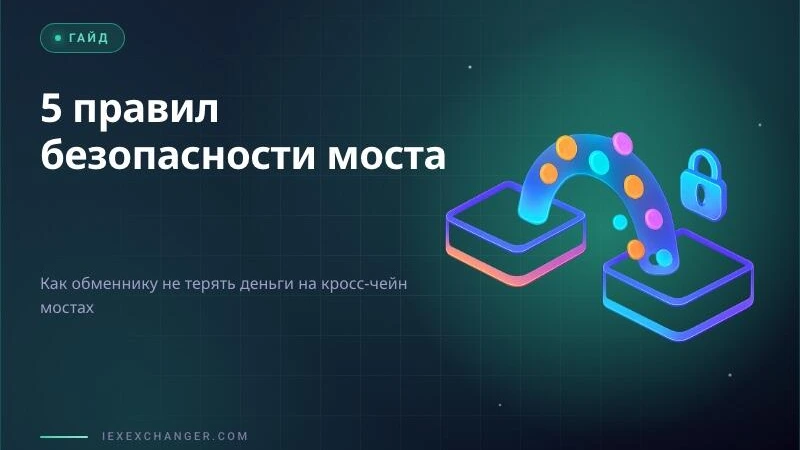
Cross-chain bridges move tokens from one blockchain to another, and for anyone running an exchanger they're an everyday tool, not some exotic gadget. You reach for a bridge when a client wants a payout on a network where you're short on liquidity right now, and buying more on an exchange would take too long. The catch: bridges remain the leakiest part of crypto infrastructure, and the money that disappears there is rarely the user's fault.
What a bridge actually is — and why you can't skip it
A bridge is a set of smart contracts and validators that lock a token on one chain and mint a “wrapped” copy on another. Think of a currency exchange booth at an airport: you hand over dollars at one window and collect euros at the next, but the safekeeping between those two windows happens inside a back office you never see.
If you run an exchanger juggling several networks — say, accepting USDT on TRC-20 and paying out on ERC-20 or BEP-20 — a bridge is usually faster than routing liquidity through a centralized exchange. You could avoid bridges entirely, but that means locking up a separate reserve for every network, which is an expensive way to freeze capital.
Where the money actually disappears
Not in the exchange rate — that part is fairly transparent. Losses happen when someone breaks the bridge's own plumbing: the contract holding the locked tokens, or the validator set that approves transfers between chains. Compromise the right number of signing keys, and a bridge can mint tokens out of thin air, or simply never release what was locked.
It's a systemic risk, not a one-off failure of some careless project. Major bridge hacks happen year after year, which is why seasoned exchanger operators treat bridges as their own risk category — closer to a counterparty than to a plain technical feature.
Rule 1: never park more on a bridge than you can afford to lose
A bridge isn't a wallet and it isn't a bank account. A sane rule of thumb: move through it exactly what a given operation needs, not a “working buffer” for the whole day. If order volume is spiky, send smaller batches more often rather than one large transfer.
Rule 2: an audit is a filter, not a guarantee
A smart-contract audit lowers the odds of a plain coding mistake, but it does nothing against validator compromise, social engineering, or an attack on the infrastructure around the bridge. Check not just whether an audit happened, but who ran it, how long the bridge has operated incident-free, and whether the team is still actively maintaining it — an abandoned project with a stale “audited” badge is riskier than a newer bridge with an engaged team.
Rule 3: spread your flow across more than one bridge
One bridge means one point of failure. If it carries all your traffic between a pair of chains, a hack or an outage freezes exactly the corridor your clients need right now. Larger exchangers typically keep at least two independent routes between their busiest network pairs and switch if one starts behaving oddly — confirmation times creeping up, for instance.
Rule 4: watch the limits and the unlock times
- Daily withdrawal cap — if it's below your peak volume, you'll hit a wall right when demand spikes.
- Finality time — anywhere from seconds to tens of minutes depending on the chain and its confirmation model.
- What happens if the bridge pauses — the team should have an official channel announcing outages and resumption timelines.
These numbers shift. What held true six months ago may not hold now, so it's worth re-checking at least once a quarter.
When bridges aren't the right call at all
If you run one stable, high-volume corridor — always swapping the same token between the same two networks — it's often cheaper and safer to just hold native liquidity on both chains directly, no bridge in the middle. Bridges earn their keep when directions are many and volume per direction is unpredictable. When there's one direction and steady volume, the extra hop is just extra risk.
Conclusion
Cross-chain bridges are useful, but never neutral: every transfer carries a risk cost worth weighing as carefully as a fee. Spread your liquidity, check the team's track record and not just the audit badge, and never park more on a bridge than you can afford to lose on a bad day. If you're building your own exchanger infrastructure and want reserves under your own control instead of scattered across other people's bridges, take a look at iEXWallet — a proprietary wallet with no middleman fee.