KYC for a crypto exchanger isn't optional infrastructure you can defer until later. Without basic client verification, your exchanger will eventually lose its payment processing, face account freezes, or get delisted from BestChange. Exchangers with solid KYC in place keep running smoothly — even as regulatory pressure tightens through 2026.
Why Exchangers Without KYC Lose More Than They Think
Many exchanger owners reason: "My clients hate verification — KYC will tank conversion." Fair point on the surface. But the other side of that equation is expensive.
Payment aggregators and banking partners increasingly require proof that you know your customers. Without it: rejected onboarding, or a sudden cut-off of a live payment channel. In 2025–2026, several major processing companies shut down accounts for hundreds of exchangers specifically because they had no KYC policy in place.
Concrete risks of skipping KYC:
- Losing your bank account or card acquiring right when volumes are growing
- Exposure as a transit point for dirty funds — a criminal matter, not just a compliance footnote
- Delisting from aggregators like BestChange or Bestexchange
- No viable path into Western markets or the MiCA regulatory zone
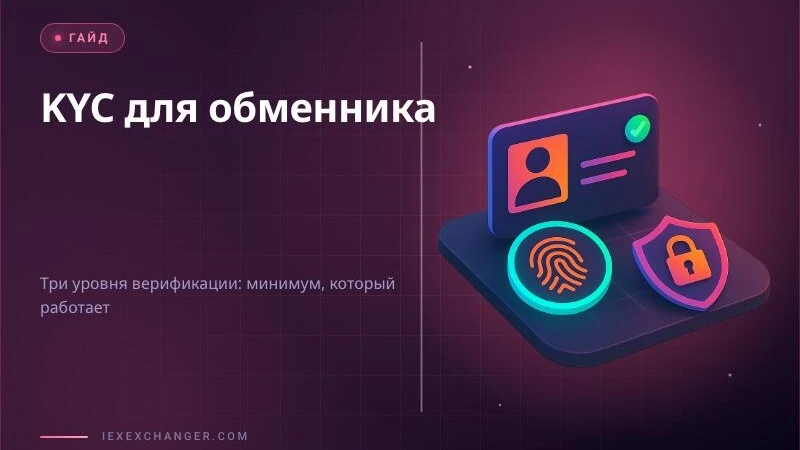
Three KYC Levels: What Every Exchanger Actually Needs
KYC isn't a single verify button. It's three tiers — and each one closes a different class of risk.
Level 1 — anonymous transactions with a cap. No verification required, but the exchange amount is limited (say, $500–$1,000 per day). Most payment partners accept this as a baseline. Log IP, device, and transaction history.
Level 2 — simplified verification (Simplified Due Diligence). Email or phone number plus a selfie with an ID document. Covers limits up to $5,000–$10,000. Eliminates the majority of transit-scheme risk.
Level 3 — enhanced verification (Enhanced Due Diligence). Passport, proof of address, source of funds. Required for large transactions and strictly regulated jurisdictions.
Most small and mid-sized exchangers only need Levels 1 and 2 — that covers 80–90% of transactions without hurting conversion on small amounts.
AML Monitoring: A Different Beast
KYC and AML are often conflated, but they're distinct tools. KYC tells you who the client is. AML (Anti-Money Laundering) tells you whether the funds they're carrying come from toxic sources — darknet markets, hacked wallets, sanctioned entities.
Without AML address screening, you can accept a perfectly verified client who's routing proceeds from a hack or a sanctioned wallet. For your exchanger, that's criminal exposure, not just an inconvenience.
The basic toolkit: address screening services such as Chainalysis, Elliptic, Crystal Blockchain, or the budget-friendly AMLBot. Screen sending and receiving addresses against sanctions lists and high-risk labels. Each check takes seconds and costs between $0.01 and $0.10 — hard to argue with that price.
What It Costs and How to Choose
The common misconception: "KYC is expensive — we'll deal with it later." In practice, there are several pricing tiers.
- Free or near-free: open sanctions databases (OFAC, EU lists), manual API checks — fine for launch and low volumes
- $50–$200/month: basic AMLBot or GetBlock screening subscriptions — good up to around $500k monthly volume
- $300–$1,000/month: Sumsub, Veriff, and similar — full automated KYC with document verification, built for growth
You don't need enterprise from day one. AML address screening plus manual Level 2 KYC already closes most risks at minimal cost — and you can upgrade as volumes grow.
When KYC Gets in the Way
Honestly: too much verification destroys conversion on small transactions. Asking for a passport to exchange $50 sends the client straight to a competitor who doesn't. KYC should be proportional to transaction size — not a one-size-fits-all gate.
Situations where a lighter approach makes sense:
- Operating in a low-risk jurisdiction with no strict AML requirements
- Average transaction size sits below mandatory identification thresholds
- Mostly returning clients whose history is already on file
The key move is documentation. Even if you're not collecting ID on every transaction, having a written KYC/AML policy reduces your exposure to partner and regulator complaints. A policy on paper costs nothing and protects a great deal.
Conclusion
KYC isn't bureaucracy. It's the price of staying operational — with payment partners, banks, and aggregators. The minimum viable setup — AML address screening, caps on anonymous transactions, and simplified Level 2 KYC — is within reach for any exchanger without heavy upfront investment.
If you're building or upgrading your exchanger, iEXExchanger provides a ready-made engine with KYC integration support, so you're not reinventing this wheel from scratch.