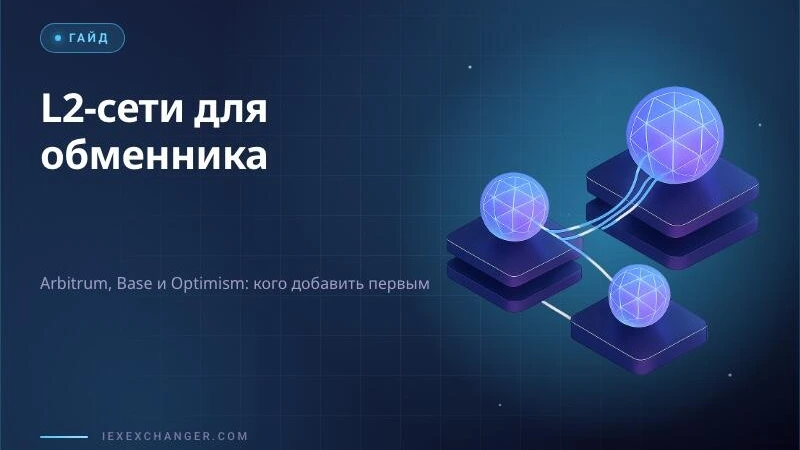
Layer 2 networks have become standard infrastructure for millions of crypto users — people move assets through Arbitrum and Base as naturally as they once sent ERC-20 tokens on mainnet. If your exchanger runs exclusively on Ethereum mainnet, a growing slice of potential users is quietly walking away to competitors who already support L2s.
The situation isn't hard to read, but choosing the right networks takes clear thinking. Not all L2s are equally mature, not all carry the same liquidity — and some on the list are better left for next year.
What L2s Are and Why They're No Longer "Exotic"
A Layer 2 is a separate network that processes transactions quickly and cheaply, then settles the final result back to Ethereum. Think of it like a payment terminal at a restaurant: the order is handled at the counter, but the money still flows to the same bank account in the end.
In 2024–2025, Ethereum mainnet fees repeatedly spiked above $15 for a simple transfer during peak hours. On most L2s, the same operation costs $0.01–0.10. That changed user habits for good. L2 transaction volumes are now comparable to mainnet by operation count — and on some days exceed it.
Arbitrum: The Mature Network with Real Liquidity
Arbitrum is the first choice for any exchanger that wants to be where the money already is. It's the oldest and most liquid of the major L2s: major DeFi protocols operate there, and it holds the deepest bridged USDT and USDC liquidity among all L2 networks.
For an exchanger, this is practical: volume is real, users are comfortable with the network, and major liquidity provider APIs already support Arbitrum addresses. The main risk is operational — you need separate hot wallets and balance monitoring for Arbitrum addresses, or things get confusing fast.
Base: Young, But Growing Fast
Base is Coinbase's L2, launched in 2023. Its defining trait: Coinbase actively channels its retail users there. That's interesting for an exchanger — the Base audience skews toward newcomers and mainstream crypto users who often want a quick swap of assets bought on Coinbase, without extra steps.
Fees are low and the network is stable. Stablecoin liquidity on Base is still thinner than on Arbitrum, and not all rate providers support it yet. But the direction is clear: in 2026, Base has moved firmly from "experimental" into genuinely operational territory.
Optimism: The OP Stack Ecosystem
Optimism's most compelling feature isn't the network itself — it's the OP Stack, the shared technology layer powering multiple chains at once: Optimism itself, Base, and dozens of others. One shared codebase means that once you've integrated one, adding another is hours of work, not weeks.
Optimism holds steady volume, though Base has overtaken it in transaction count. For an exchanger, it's a solid second or third network to add — especially if you're planning to work with protocols from the broader Superchain ecosystem.
ZK-Rollups: Add Now or Wait?
ZK-rollups are technically more advanced than optimistic rollups (Arbitrum, Optimism, Base). They use cryptographic proofs instead of a waiting period, speeding up transaction finality.
In practice, both zkSync Era and Starknet are still fighting for liquidity and user share in 2026. Volume exists, but it's an order of magnitude smaller than Arbitrum. Liquidity providers and rate automation tools support ZK networks less reliably. If you're already running three L2s from the list above — go ahead and add one. If not — start with Arbitrum and Base, and leave ZK-rollups for the next phase.
How to Choose Which L2s to Add First
Three criteria that genuinely matter for an exchanger:
- Stablecoin trading volume. Exchangers run on USDT and USDC. Look at where these coins have real on-chain liquidity — DefiLlama and Dune Analytics publish this data openly.
- Your rate provider's support. If your rate automation can't handle a specific L2, adding that network creates manual overhead that cancels out any benefit.
- Operational load. Every new network means separate balance monitoring, separate hot wallets, separate reserve float. Three networks running cleanly beats seven you can't keep up with.
A sensible starting configuration for most exchangers in 2026: Ethereum mainnet + Arbitrum + Base. Add more as your audience demands it.
Conclusion
L2 networks aren't a trend to track — they're already part of most users' default flow. Ignoring them means losing real volume. Arbitrum and Base are the minimum starting point; Optimism follows with minimal effort; ZK-rollups can wait another year or two.
If you're building or planning to launch an exchanger with multi-L2 support, take a look at what iEXExchanger offers — an exchanger engine with flexible network configuration and automated rate management built in.