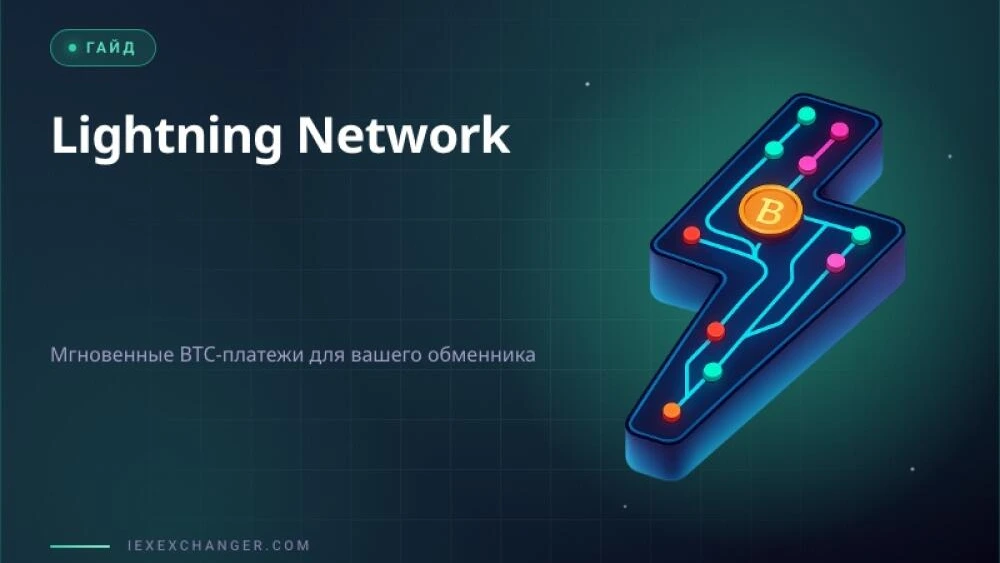
Lightning Network for crypto exchangers has moved well past the experimental stage. Bitcoin arrives in 1–3 seconds for fractions of a cent in fees — instead of waiting 10–60 minutes in the mempool (Bitcoin's queue of unconfirmed transactions). While your competitor's client stares at a loading spinner, yours has already received funds and moved on. Here is how it works and what integration actually takes.
How Lightning Network Works Under the Hood
Lightning is a network of payment channels built on top of Bitcoin. Think of it like a running tab between a supplier and a regular customer: they set up a shared deposit once, then settle individual transactions instantly — as many times as they need. Only when they close the tab does the final balance get written to the blockchain.
Technically: two parties lock Bitcoin in a shared on-chain wallet. After that, they can send funds back and forth inside the channel — no blockchain entries, instant settlement. A web of such channels lets you pay anyone in the network, even without a direct connection: Alice → Bob → Victor, as long as each pair has an open channel.
Lightning fees are set by the routing nodes. In practice: 1–10 satoshis (one satoshi = one hundred-millionth of a BTC) plus 0.01–0.1% of the amount — working out to $0.001–$0.05 per payment. During weeks when on-chain Bitcoin fees spiked to $20 per transaction, Lightning kept running at the same near-zero cost.
What Lightning Brings to an Exchanger in Practice
The core benefit is faster order completion. Client sends BTC via Lightning, you get an instant confirmation, swap executed. No "please wait, the network is congested."
- Fewer abandoned orders. Waiting is the main reason a client switches to a competitor. Near-instant BTC receipt removes that friction entirely.
- Real fee savings. When Bitcoin is congested, on-chain fees can hit $5–20 per transaction. Lightning brings that to cents — direct savings on every order processed.
- A new audience. A growing share of users already holds Lightning wallets — Phoenix, Breez, Wallet of Satoshi. Supporting LN means you can serve this segment.
- A genuine competitive edge. "BTC swap in 3 seconds" is a real claim, not a marketing stretch.
How to Integrate Lightning Into Your Exchanger: Three Paths
The right choice depends on your technical capacity and transaction volumes.
Path 1 — Self-hosted node (LND or Core Lightning). You run a full Lightning node on your own server and manage channels yourself. Full control, minimal third-party fees — and full responsibility. You need someone who understands Lightning: liquidity management, channel monitoring, Static Channel Backups (SCB). This makes sense for high-volume exchangers with dedicated technical staff.
Path 2 — Managed node via a provider. A Lightning Service Provider (LSP) handles the infrastructure; you manage channels through a clean dashboard (Voltage and similar). Simpler than self-hosting, cheaper than a payment processor — a sensible middle ground for mid-sized operations.
Path 3 — Third-party Lightning processor. You plug in a ready-made API (OpenNode, Strike), the processor accepts LN payments and credits your account in standard BTC or fiat. Minimum technical overhead, maximum simplicity — with a processor fee of typically 0.5–1%.
For most new exchangers, Path 3 is the optimal starting point: ship fast, then migrate to your own infrastructure as volumes grow.
The Real Pitfalls Nobody Talks About
Lightning is a mature technology — but not a frictionless one. Better to know the gotchas upfront.
Inbound liquidity problem. To receive payments, your node needs inbound capacity — meaning someone must open a channel to you, or you must spend your own funds to create room for incoming transfers. For a new node this is non-trivial: it takes either time or money to purchase liquidity from an LSP.
Routing unreliability for large amounts. A 0.001 BTC payment routes easily. A 1 BTC payment is a different story: intermediary nodes may not have sufficient liquidity across the full route. The practical rule of thumb: Lightning is reliable up to about 0.05–0.1 BTC per payment; above that, on-chain is safer.
Your node must be online. A standard Bitcoin address accepts payments even when your computer is off. A Lightning node does not — it must be running the moment a payment arrives. Server downtime means you are unreachable to clients.
Force-close risk. If a counterparty tries to broadcast an outdated channel state — essentially attempting theft — you need a watch tower (a monitoring service) to catch and contest it. Without one, that theoretical attack vector stays open.
When Lightning Is Not the Right Tool
Sometimes skipping Lightning is the smarter call.
- Low volume. At 10–20 orders per day, setup and maintenance costs will not pay off. Wait until traffic justifies the investment.
- Large B2B payments. For big single transfers, an on-chain transaction with 1–2 confirmations is safer and more predictable.
- Stablecoin-focused operations. Lightning only carries Bitcoin. USDT, USDC and other tokens travel over separate networks — TRC20, ERC20, BEP20.
There is no point adding technology just to tick a box. Lightning makes sense when BTC settlement speed genuinely affects your conversion rate — and when you have the resources to keep the infrastructure running.
Conclusion
Lightning Network is a mature tool with concrete benefits: instant BTC, near-zero fees, access to a growing user base. But behind a simple Lightning invoice sits non-trivial infrastructure — liquidity, channels, monitoring. Start with a third-party processor to ship fast; build your own node as volumes grow.
If you are developing or launching a crypto exchanger and thinking about settlement speed, take a look at iEXExchanger — a ready-made exchanger engine built for modern payment workflows.