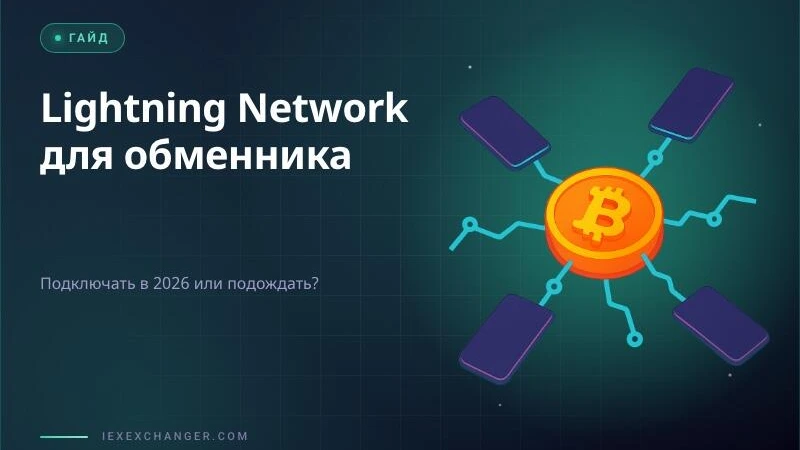
Lightning Network is a payment layer built on top of Bitcoin that settles transactions in seconds for near-zero cost. For a crypto exchange operator, that sounds like an obvious upgrade. Whether it's actually worth integrating in 2026, though, depends on your volume, your audience, and your appetite for technical complexity.
What Lightning actually gives your exchange
Settlement is essentially instant: payments route through pre-funded channels between nodes, bypassing the Bitcoin blockchain entirely. Fees run from zero to a few satoshis, regardless of network congestion. That matters when a client wants to swap 0.001 BTC and an on-chain fee could eat 30–50% of the amount during peak hours.
Lightning also opens the door to micro-payments and lets you serve the growing segment of users running LN-compatible wallets — Phoenix, Muun, Wallet of Satoshi. In some niches, that's already a meaningful share of the customer base.
Where Lightning falls short
BTC only. There is no USDT, no ETH, no USDC over Lightning. If your clients mostly swap stablecoins, Lightning is simply irrelevant to your operation.
Second constraint: channels need pre-funded liquidity. If your side of a channel runs dry, payments fail outright. Managing inbound and outbound channel capacity is an ongoing operational task you can't fully automate away — and that's exactly what makes Lightning operationally expensive.
Technical requirements: the honest version
A bare-minimum Lightning setup means: a full LN node (LND or CLN), a server with near-100% uptime, active channel management, secure key backups, and monitoring. Managed cloud options barely exist — you either run the node yourself or rely on a custodial LN provider, which partially defeats the purpose.
Also: standard Lightning doesn't integrate cleanly with KYC workflows. If your exchange verifies clients, you'll need custom application-layer logic on top of any LN implementation.
When the integration actually pays off
Lightning makes business sense when:
- a meaningful share of your clients moves small BTC amounts (under 0.05 BTC);
- you have a technical team — or can hire an LN specialist;
- your market already adopts Lightning (El Salvador, parts of Latin America, certain European niches);
- Bitcoin is your primary asset, not stablecoins.
If none of those apply, Lightning will cost more to run than it earns back. It's not a bad technology — it's a precise tool for a precise use case.
Conclusion
Lightning Network is mature but niche. For an exchange focused on BTC micro-payments and a technically minded audience, it cuts fees and speeds up settlement. For the majority of stablecoin-heavy exchanges, it adds complexity without meaningful return.
If you're building an exchange from scratch or expanding your payment infrastructure, take a look at the ready-made crypto asset management solution at iEXWallet — your own wallet with no third-party fees.