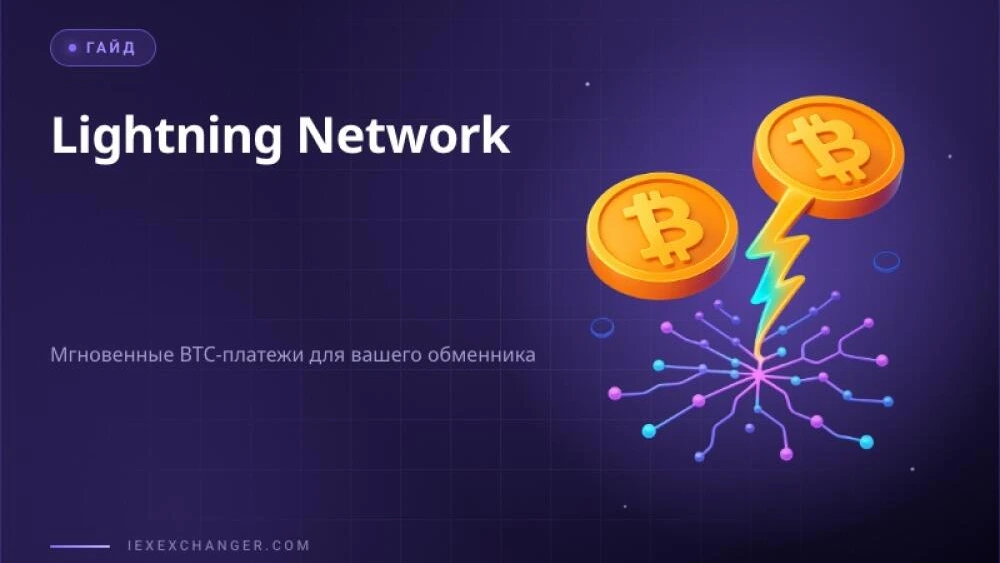
Lightning Network for crypto exchangers is a way to accept and send Bitcoin in seconds, for a fraction of a cent in fees. The technology runs on top of the main Bitcoin network and processes payments without recording every transaction on the blockchain. If you run an exchanger and want to cut fee costs and speed up settlements with clients, Lightning deserves serious consideration.
How Lightning Network Works
Lightning is a network of payment channels. Two parties lock BTC in a shared wallet via a single on-chain transaction, then transfer coins between themselves as many times as they like — off-chain. Closing the channel settles the final balance on the main network in one transaction. Settlement speed is typically under a second; fees amount to just a handful of satoshis.
Lightning does not record intermediate transfers in a public ledger. Payments route through a chain of channels: no intermediate node knows who the sender or receiver is. This makes LN attractive for confidential settlements, but raises questions for an exchanger's AML policy.
What an Exchanger Gains from Lightning
Three practical advantages that change the economics of settlements:
- Speed. Clients don't wait 10–60 minutes for block confirmations. Settlement is instant — critical when the rate is moving.
- Low fees. During network congestion, on-chain BTC transaction fees can exceed $10–15. Lightning costs a handful of satoshis. For exchangers processing many deals, the savings add up fast.
- Micropayments. You can accept amounts from 1,000 satoshis — opening new scenarios: referral rewards, fractional conversions, bonus payouts to clients.
Limitations and Pitfalls
Lightning is not a silver bullet. Here are the real challenges exchangers face in practice:
- Channel liquidity. To receive incoming LN payments you need inbound liquidity. You either buy it or negotiate with large nodes. Without it, clients simply cannot send you a payment.
- Node management. Running your own Lightning node is infrastructure work: servers, monitoring, channel backups. A backup mistake can result in losing funds locked in a channel.
- AML/KYC. Lightning transactions are harder to trace than on-chain ones. If your exchanger operates in a regulated jurisdiction, you need a clear policy: at what amounts to require verification and how to document LN transfers.
- Payment limits. Payment size is capped by the liquidity of the specific channel. Large amounts are safer to settle on-chain.
Three Ways to Connect Lightning to Your Exchanger
The right path depends on your business scale and your team's technical capabilities:
- Self-hosted node (LND, Core Lightning, Eclair). Full control, but requires DevOps expertise: channel monitoring, automatic rebalancing, reliable backups.
- Custodial providers (OpenNode, Voltage, Strike API). Connect an API and the provider manages liquidity. Fast to launch, but you depend on a third party.
- Hybrid approach. Accept Lightning via a provider, process large payouts on-chain through your own wallet. Optimal for mid-volume exchangers.
Either way, you'll need changes to your exchanger engine: invoice support, payment status handling, limit configuration. Not a one-day job — but a manageable task for an experienced team.
When Lightning Is Not the Right Fit
If your Bitcoin volume is under 50–100 deals per day and the average ticket is above $200, the fee savings won't justify the infrastructure overhead. On-chain Bitcoin with dynamic fee estimation will serve you just fine — without the added complexity.
Lightning makes sense for high volumes of small transactions, clients in countries with unreliable banking infrastructure, or in products built around gamification and micro-rewards.
Conclusion
Lightning Network is mature technology with real fee savings and instant settlements. For exchangers with high BTC deal volume it meaningfully improves the economics. But it's an infrastructure project: liquidity, monitoring, AML policy — all of this needs to be planned upfront. If you're just launching an exchanger or evaluating your tech stack, iEXExchanger gives you a solid foundation — from the exchange engine to payment network integrations.