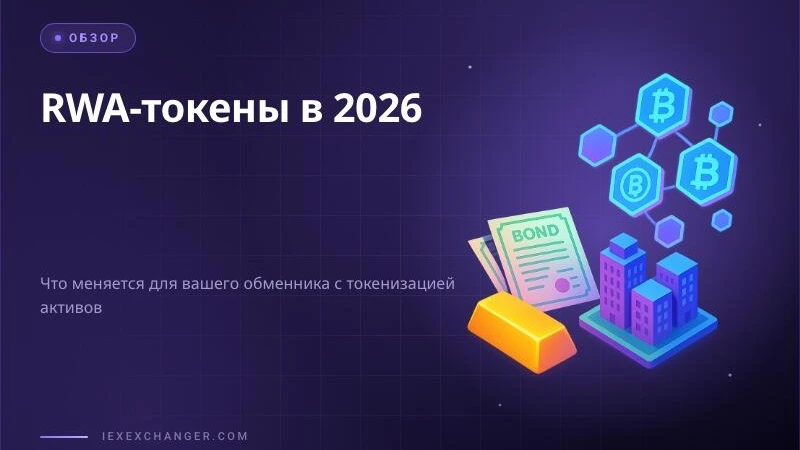
Real-world asset tokenization (RWA) is one of the few crypto narratives of 2026 backed by real money rather than speculative heat. Behind RWA tokens sit concrete assets: government and corporate bonds, equities, gold, real estate, money-market funds. The market has grown several times over in the past two years — and for an exchanger operator, that is not just a headline. It is a new client category, new trading pairs, and new operational requirements to navigate.
How an RWA Token Works
The mechanics are straightforward: a company or fund buys an asset — say, short-term U.S. Treasuries — places it with a regulated custodian, and issues tokens, each representing a fractional ownership claim on that asset or its yield. Simple in theory; the complexity lives elsewhere.
The most common example is the tokenized money-market fund. A protocol issues a $1 token that accrues daily yield from short-term bonds — essentially a stablecoin that earns interest. Prominent players include BlackRock (BUIDL), Franklin Templeton, Ondo Finance, and Maple Finance. Most tokens run on Ethereum or Polygon.
Which Assets Get Tokenized Most
The market has concentrated around a few asset classes:
- Government bonds — the largest segment. Simple structure, predictable yield, strong demand from DeFi protocols that need safe collateral.
- Corporate debt and private credit — fast-growing. Protocols like Maple route crypto capital into real business loans.
- Precious metals — gold and silver on-chain have existed for years (PAX Gold, Tether Gold), volumes remain modest.
- Real estate — legally the most complex class; active experimentation, but no mass market yet.
For exchanger operators, the first two classes are the practical focus — they have genuine liquidity and a functioning secondary market.
What Changes for Your Exchanger: New Pairs, New Clients
RWA tokens are already showing up on major DEXs and a handful of CEXs. If your exchanger routes through exchange APIs or liquidity aggregators, some are technically reachable today.
In practice, this means a new type of client: people looking for a yield-bearing stablecoin or a digital stake in gold. They are not here to speculate — they want conversion. These clients transact less frequently, but their average ticket is larger. Integration takes a few steps: confirm the platform supports the relevant tokens, configure accurate pricing (RWA spreads are often wider than major crypto pairs), and verify wallet compatibility.
Compliance: Where RWA Is More Complex Than Regular Crypto
Here is the uncomfortable truth most overviews skip. Most RWA tokens carry a built-in whitelist — only pre-verified addresses can transact in them. BlackRock BUIDL was initially limited to qualified investors with a $5M minimum. Thresholds are coming down, but the restrictions have not gone away.
For an exchanger, this means:
- You cannot accept an RWA token from a client without knowing whether their wallet is authorized by the issuer.
- KYC/AML stops being a recommendation and becomes a technical necessity.
- Regulatory classification varies: a security under EU law, an instrument with undefined status in many other jurisdictions.
Before adding RWA pairs, you need a clear picture of the issuer's jurisdiction and counterparty requirements — otherwise you get a technically working integration and a legally fragile position.
When RWA Is Not Your Play
RWA tokens are not a universal upgrade. There are situations where adding them creates more problems than revenue:
- Operating in a grey zone — RWA inevitably pulls in a KYC chain, which does not mix with anonymous exchanges.
- Thin liquidity — many RWA tokens trade with wide spreads or have no real secondary market. Easy to receive, hard to offload.
- Incompatible infrastructure — you need wallets that support ERC-1400 or ERC-3643 (permissioned token standards). A standard ERC-20 wallet may simply reject the transfer.
And honestly: RWA is still early-stage. Protocols fail, contracts get exploited, regulators are still writing the rules. Being first means absorbing some of those risks first.
Conclusion
Real-world asset tokenization is not another hype cycle. It is backed by serious institutional players and genuine demand for crypto instruments anchored in tangible assets. For exchanger operators, it is a compelling niche — provided your infrastructure, KYC setup, and legal position are ready for it.
If you are building or scaling a professional crypto exchanger and want a platform built specifically for operators — not for end users swapping coins — iEXExchanger is worth a close look.