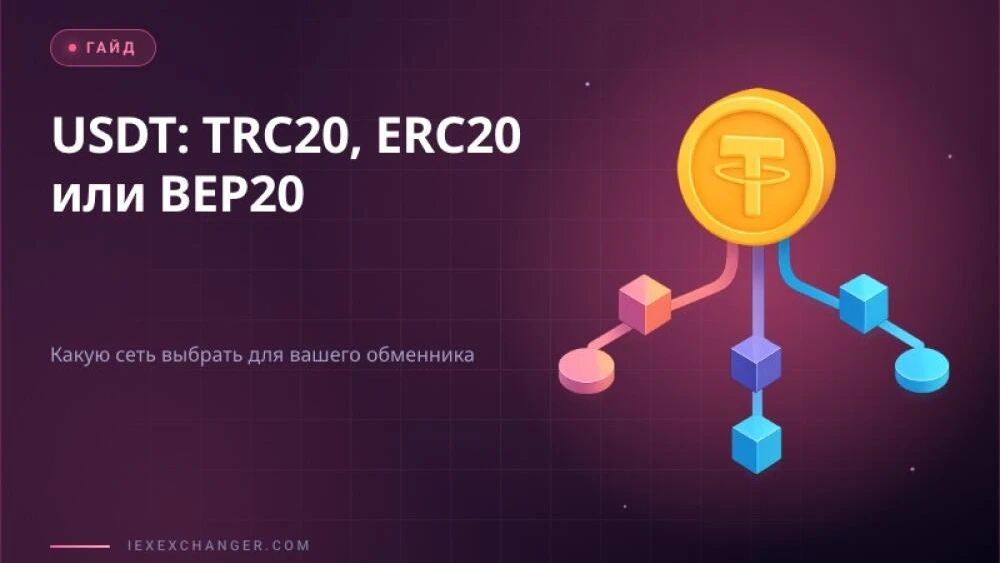
The USDT network you choose for your crypto exchange is a financial decision you make once but live with every single day. TRC20, ERC20, and BEP20 are the same token on three different rails, each with different fees, speeds, and partner compatibility. Pick the wrong one and you're handing clients straight to a competitor.
Why Network Choice Matters More Than It Looks
Many exchange operators treat this as a technical question and go with whatever the platform supports by default. It's not. A client who's used to sending USDT over TRC20 for a few cents won't pay several times more on ERC20 — they'll leave. The flip side: an exchanger built only on TRC20 may run into rejections from regulated counterparties that no longer accept TRON-sourced transactions.
TRC20: Cheap and Fast — With One Real Catch
USDT on the TRON network is the go-to choice for retail crypto exchangers and P2P platforms. Transfer fees are minimal, confirmations arrive in seconds. TRON was purpose-built for high-frequency small payments, and it does that well.
For an exchanger serving retail clients with average transactions up to $1,000–2,000, TRC20 is almost always the cheapest option. The catch: a number of regulated exchanges and fintech companies have tightened their policies on TRON-network transactions — the share of addresses linked to sanctions lists there is disproportionately high. If your partners operate in the EU or US, check their compliance policy before you build your whole operation around TRC20.
ERC20: Expensive, but the Industry Standard
The Ethereum network is the de facto standard for institutional crypto operations. Any major exchange, any payment aggregator accepts ERC20 without extra checks or questions. That is exactly why corporate clients and fiat gateways typically require it.
The downside is fees. During periods of network congestion, a single USDT transfer can become noticeably expensive — for small exchanges, this makes the transaction unattractive for the client. ERC20 makes sense for large amounts, corporate clients, or wherever partner compatibility outweighs transaction cost. As the only option for retail traffic, it will drive clients away.
BEP20: Fast and Cheap, Smaller Reach
BNB Smart Chain combines low fees and fast confirmations — similar to TRON, but on different infrastructure. It's popular with Binance users and in Asian markets.
The downside is narrower compatibility. Not every exchange or exchanger supports BEP20 USDT. Cases where a client accidentally sends BEP20 to an ERC20 address happen regularly and require manual handling. BEP20 makes sense as an add-on option — but not as your only network unless you know your audience very precisely.
Three Criteria to Make the Right Call
There is no universal answer. The right strategy depends on three things:
- Average transaction size. Under $500 — TRC20 is almost always cheaper for the client. Above $2,000 — ERC20 is viable, since the fee takes up a smaller percentage.
- Counterparty type. Working with banks, regulated exchanges, or fiat gateways — ERC20 is often required. Retail audience — TRC20 reduces drop-off.
- Geography. CIS and Asia — TRC20 dominates. Europe and the US — ERC20 is standard, and TRC20 raises compliance questions on the partner's side.
For most exchangers, the smart move is to support both TRC20 and ERC20 in parallel and give the client a choice at the point of exchange. This covers both the retail and corporate segments without losing either one.
Conclusion
TRC20 wins on cost for retail operations. ERC20 is essential for institutional compatibility. BEP20 is a useful add-on for specific audiences. An exchanger that supports multiple networks and lets the client choose doesn't lose clients in any segment. Whether you're building from scratch or adding network options to an existing operation, iEXExchanger offers a ready platform to get there faster.