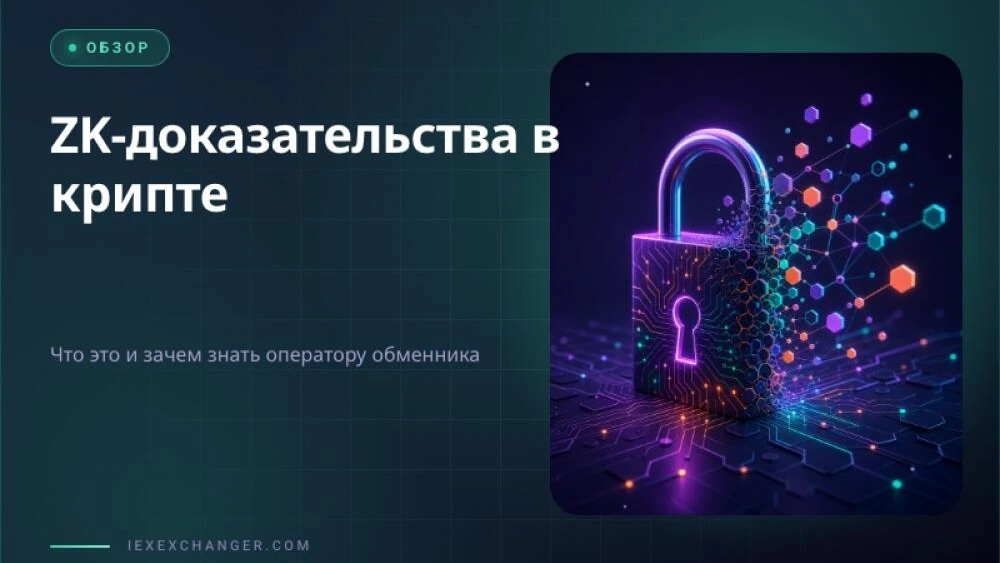
Zero-knowledge proofs (ZKP) are a cryptographic method that lets one party prove a fact without revealing the underlying data. This technology has become one of the main engines of blockchain development in recent years — and crypto exchanger operators are encountering it more often: in ZK-rollups, new KYC models, and networks that clients already use.
How It Works — No Heavy Math Required
The core idea: one party (the prover) convinces another (the verifier) that a statement is true without showing the underlying data. The classic analogy: you prove you know a safe's combination without saying it aloud. In blockchain, this means you can confirm a transaction is valid without revealing the amount or the parties involved.
Two main families: zk-SNARKs — compact, fast to verify, but require a trusted setup; zk-STARKs — no trusted setup needed, quantum-resistant, but produce larger proofs. Both are actively used in 2026. Which one a given protocol uses depends on its specific trade-offs.
ZK-Rollups: When This Directly Affects Your Exchanger
ZK-rollups are Layer 2 networks that batch hundreds of transactions off-chain, generate a ZK proof of their validity, and post it to Ethereum. The result: significantly higher throughput, fees that are orders of magnitude lower — with security inherited from the base layer.
- zkSync Era — one of the most widely deployed; supports EVM and major DeFi protocols.
- Polygon zkEVM — focused on Ethereum compatibility, convenient for migrating existing contracts.
- StarkNet — uses zk-STARKs, actively building its own ecosystem.
- Linea — built by ConsenSys, natively integrated with MetaMask.
If your exchanger handles ERC-20 tokens — USDT, USDC, ETH — a growing share of clients holds assets on these networks, not on mainnet. Supporting at least one ZK-rollup is becoming a practical necessity, not an edge case.
Privacy Without Anonymity: ZK and Compliance in 2026
One of ZKP's less obvious applications is privacy-preserving compliance. The idea: a user proves they passed KYC or that their address isn't on a sanctions list — without handing that data to the service. The regulator gets confirmation; the exchanger never accumulates passport databases.
Protocols like Polygon ID already issue ZKP-based verifiable credentials. This isn't a distant prospect — pilots are live in several jurisdictions. For exchangers looking to prove compliance without storing sensitive data, it's a genuinely interesting direction.
Limitations: When ZK Isn't the Right Choice Right Now
Honest about the weak spots. Generating ZK proofs is computationally expensive — though hardware and algorithms are improving fast. Auditing ZK circuits is harder than auditing ordinary smart contracts: a bug may not trigger an obvious failure but can silently undermine security guarantees. And one more thing: regulators in some countries view privacy-ZK solutions with suspicion, much like they once viewed mixers. Before integrating ZKP into an exchanger's processes, it's worth consulting a lawyer familiar with your jurisdiction.
Conclusion
Zero-knowledge proofs have long since left the realm of academic papers — they're working infrastructure powering rollups, new KYC models, and high-speed payment networks. An exchanger operator doesn't need to master the math behind zk-SNARKs, but understanding which networks run on ZK and how this technology is reshaping the compliance landscape is genuinely useful. For those building or scaling their own exchanger, iEXExchanger offers a ready-made platform built to meet today's market requirements.