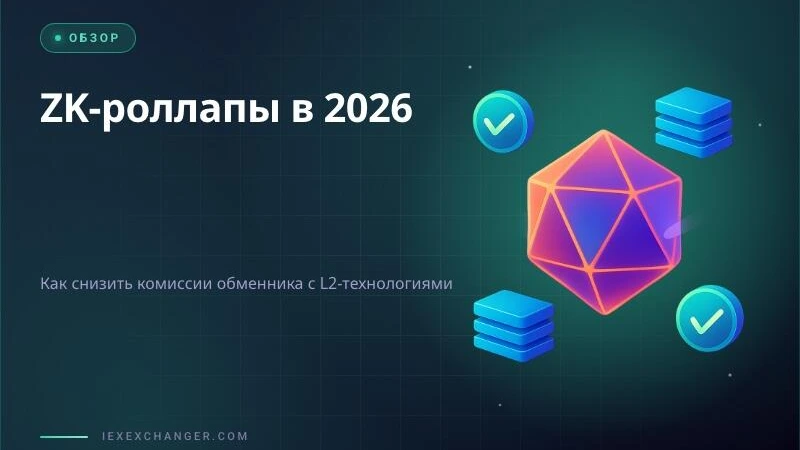
ZK-rollups are the technology finally making Ethereum viable for high-volume crypto exchangers. In 2026, a USDT transfer on zkSync costs under $0.05 — compared to $5–15 on the Ethereum mainnet during busy periods. If your exchange processes ERC-20 assets, this changes the unit economics of your business.
What ZK-Rollups Actually Are
Think of a notary who, instead of certifying a thousand individual documents, issues one consolidated summary with a mathematical guarantee of correctness. A ZK-rollup does the same: it executes thousands of transactions off-chain, then posts a single cryptographic proof — a ZK-proof — to Ethereum. That proof verifies instantly. Forging it is mathematically impossible.
ZK stands for Zero-Knowledge — a proof that confirms the correctness of computations without revealing the details of each transaction. This is about speed and scale, not anonymity — a distinction that often gets confused.
ZK vs. Optimistic Rollups: The Key Difference
Both are Layer 2 solutions for Ethereum, but with fundamentally different logic. Optimistic rollups (Optimism, Arbitrum) trust transactions by default and allow 7 days for challenges. ZK-rollups prove correctness mathematically — immediately.
- Finality: ZK — minutes. Optimistic — 7 days.
- Withdrawals: ZK lets you withdraw same-day. Optimistic means a week's wait or paying for a fast bridge.
- Cost at volume: generating a ZK-proof is compute-intensive, but at high transaction volume the per-transaction cost drops significantly.
- EVM compatibility: once a weakness for ZK — now solved by all major players.
For an exchanger, a 7-day withdrawal window means locked-up liquidity. Money sitting in a bridge is money not working.
Where the ZK Market Stands in 2026
According to L2Beat, the combined TVL on ZK-rollups exceeded $8 billion in 2026. zkSync Era leads by transaction volume, StarkNet by number of protocols. Polygon zkEVM is heavily used for stablecoins: Tether and Circle issue USDT and USDC natively on multiple ZK networks, no bridge required.
A newer development: ZK-native chains built from the ground up for zero-knowledge proofs, without EVM compatibility. They're faster and cheaper, but require custom integration — a path for builders starting from scratch.
What Changes for Your Exchange
If your exchanger handles ETH, ERC-20 USDT, or other Ethereum assets, ZK-rollups shift several parameters at once.
- Customer fees: USDT transfer on zkSync costs $0.02–0.05 versus $5–15 on mainnet. Customers notice immediately.
- Settlement speed: finality in minutes, not hours. Faster turnover, less waiting.
- Liquidity: no need to freeze capital in a 7-day bridge. Money stays in circulation.
- New risks: several ZK networks still run sequencers controlled by a small multisig — a centralization risk worth tracking.
When ZK-Rollups Won't Help
Honestly: not every exchanger benefits. If you work with Bitcoin, Tron USDT, or fiat pairs — Ethereum ZK-rollups simply don't apply. If your transaction volume is low and mainnet fees aren't eating your margins, the integration complexity of L2 may not be worth it.
One more point: ZK-proofs don't mean privacy. Transactions on L2 are public. The technology solves cost and speed problems — not confidentiality. Don't confuse it with Zcash or Monero.
Conclusion
ZK-rollups have crossed the threshold from promising research to production-ready product. For exchangers running on ERC-20 assets, they're a concrete tool to cut fees and speed up settlements. The due diligence checklist: TVL, sequencer decentralization, native stablecoin support on the target network.
If you're building or scaling your own crypto exchange and want a platform where modern network support is built into the architecture from day one, take a look at iEXExchanger — a ready-made engine for launching your own exchanger.