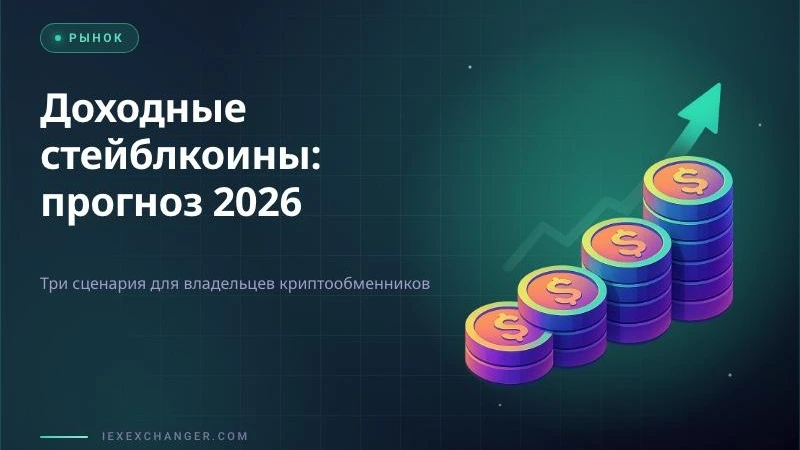
Yield-bearing stablecoins — tokens like USDe, sUSDS or USDY — don't just track the dollar, they pay you interest on top through the issuer's built-in strategy. In 2026 they sit in an awkward spot between a convenient customer product and a regulatory headache that exchanger owners need to price in separately from the exchange rate.
What Yield-Bearing Stablecoins Actually Are
Think of plain USDT as cash in a safe — it just sits there, same amount every day. A yield-bearing stablecoin behaves more like a savings account: same dollar peg, but the issuer puts reserves into Treasury bills, staking or lending strategies and passes a slice of the return back to you. That's why the balance quietly ticks up day by day, no action required.
The core difference: a plain stablecoin is a settlement tool. A yield-bearing one is already a financial product that behaves a lot like a money-market fund. That line is exactly where the regulatory questions start.
Why Regulators Suddenly Care
As long as a stablecoin just stands in for cash in a transfer, it fits neatly into "payment instrument." The moment it starts paying the holder a return, it starts looking like a security or a fund share — and that drags in disclosure rules, licensing and limits on who it can even be sold to. US and EU regulators are increasingly drawing exactly that line between a "payment stablecoin" and a "stablecoin as an investment product."
Three Scenarios for 2026
There's no single clean forecast here — too many open branches across different legal systems. But three directions are actually being discussed by people in the industry right now:
- Supervised growth. If regulators carve out yield-bearing stablecoins as their own legal product category, they stay in the market — just through licensed issuers, with limits on direct retail distribution.
- Market split. If authorities instead force a hard line between payment and investment tokens, yield-bearing versions drift into crypto-native and DeFi settings, while retail payment products keep only "plain" stablecoins with no built-in interest.
- Jurisdictional fragmentation. If no shared international standard emerges, yield-bearing stablecoins stay open to retail users in some countries and get restricted to accredited or institutional investors in others — forcing an exchanger with cross-border customers to run separate product lines.
What This Means for an Exchanger
For an exchange operator, a yield-bearing stablecoin isn't just "one more ticker on the list." If the issuer's underlying strategy wobbles — a sharp rate move, a counterparty problem — the yield can pause or even dip negative for a while, and you're the one explaining that to the customer, not the issuer. There's also the compliance angle: are your procedures ready for an asset that might legally be a financial product rather than just a "digital dollar"?
What to Check Before You List One
Before adding a yield-bearing stablecoin to your supported assets, walk through this honestly:
- Reserve transparency — is there a regular, independent report on what the reserves are actually invested in;
- Legal status specifically in your jurisdiction and your customers' jurisdictions;
- Payout history — has the yield been steady, or has it already been paused or cut;
- Liquidity — can a large balance actually be withdrawn fast without moving the price;
- Independent smart-contract audits and the issuer team's track record.
Conclusion
Yield-bearing stablecoins aren't going away as a topic in 2026 — it's simply too convenient a product for a customer who wants their dollar balance to do at least something while it sits there. But for an exchanger, it's an asset with an extra layer of risk and responsibility, not something you add to the list by default just because it's trending. If you're still building out the product lineup and asset policies for your own exchanger, it's worth starting from a ready-made platform where that groundwork is already done — like iEXExchanger.