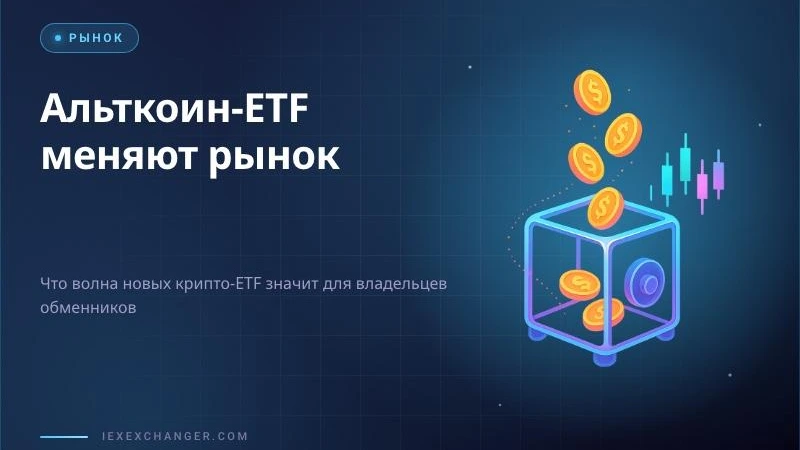
Altcoin ETFs are the reason the crypto fund market no longer means just two coins. A couple of years ago, a crypto ETF meant bitcoin or ether — full stop. Now the list is longer, and that's not cosmetic: it's a brand-new demand channel that simply didn't exist before.
What actually changed in the ETF market in 2026
Short answer: crypto ETFs stopped being a two-coin story. Funds tied to other major assets reached the market, giving institutional money a legal, regulated way to get exposure without buying tokens directly on an exchange.
Sounds dry, but the point is simple. A big fund that wanted exposure to a specific coin used to have two options: buy it directly (with all the custody and compliance headaches that brings), or skip the market entirely. Now there's a third path — buy fund shares through an ordinary broker, like any other security.
Why this is bigger than 'another Wall Street product'
For someone running an exchanger, this isn't abstract financial-press news — it reshapes the very form of demand for specific coins. Buying a token on the spot market versus buying ETF shares is a bit like the difference between standing in a grocery line and ordering delivery: the end result looks similar, but the mechanics of demand are completely different.
Money flowing through an ETF doesn't land in ordinary users' wallets and doesn't create direct demand on exchange platforms. But it moves the asset's price — and that's the exact rate your exchanger calculates, even without a single extra transaction hitting the blockchain.
How altcoin ETFs reshape demand for specific coins
Picture an exchanger holding part of its liquidity in a mid-cap coin. Before the fund launched, price mostly moved on retail demand and headlines. Once the fund exists, there's a third player — large ETF share purchases and sales that are hard to see directly but push the asset's price all the same.
- Volatility doesn't disappear — it just gets a new participant that moves in large blocks.
- Spreads on individual coins can widen temporarily during big ETF flow days.
- Correlation between 'ETF coins' and the rest of the market sometimes rises, sometimes falls — hard to call in advance.
The risks nobody puts in the brochure
The biggest myth is that an ETF makes an asset 'safer' and its demand predictable. In practice, a fund is just another large market participant, not insurance against sharp moves. Outflows from a fund can reverse a trend just as violently as inflows built it.
One more wrinkle: ETFs trade during stock-exchange hours, while crypto trades around the clock. Between a traditional market's close and its next open, an asset's price can drift noticeably — and your exchanger meets that move long before institutional capital gets a chance to react.
What this means for exchanger owners, practically
No reason to panic, but a couple of habits are worth revisiting.
- Watch fund inflow/outflow headlines, not just the coin price — they're a leading indicator of rate moves.
- Don't park all your liquidity in one 'hot' coin just because it got an ETF — concentration risk doesn't shrink because the buyer wears a suit.
- Automate rate updates so your exchanger doesn't lag the market during sharp moves — manual recalculation during those hours costs more than any subscription.
Conclusion
Altcoin ETFs are neither a threat nor a rescue for exchangers — they're a new source of market movement to track alongside retail demand and headlines. Whoever watches this factor reacts faster and loses less on spreads. You can automate rate updates and cut the manual load on your exchanger with iEXExchanger's BestChange rate automation.