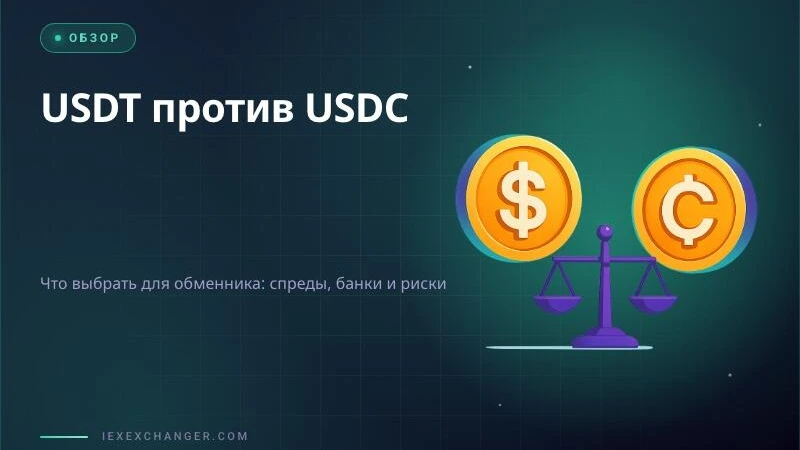
USDT and USDC together control more than 85% of stablecoin trading volume, and both show up in virtually every crypto exchange. But if you're choosing the primary settlement stablecoin for your exchange, saying "they're basically the same" is the wrong call. Spreads, banking friction, and reserve risk behave differently in practice — and those differences show up on your bottom line.
What each one actually is
USDT is issued by Tether Ltd, registered in the British Virgin Islands. Market cap exceeds $120 billion, making it the world's most liquid stablecoin. Reserves consist mostly of US Treasury bills and short-term instruments — but there's still no independent GAAP audit, only quarterly attestations from a third-party firm.
USDC is issued by Circle, a US company regulated by FinCEN. Reserves: 100% US T-bills and bank deposits, with monthly independent attestations. In 2024, Circle filed for an IPO — which tells you something about the level of regulatory transparency they've committed to.
Spreads and liquidity: where you make more
For an exchange, the spread is your margin. USDT leads in trading volume on Binance, OKX, Bybit, and most other platforms. USDT pairs — against USD, RUB, KZT — consistently show tighter bid-ask spreads on OTC markets than USDC equivalents.
USDC is well represented on Coinbase and Kraken, which have large US and European user bases. If your exchange serves those markets or processes EUR/USD transfers via bank rails, USDC can give you better conditions there specifically.
Short version: for CIS markets, USDT has no real liquidity competition right now. For European flows, it's worth running both.
Banking compliance: where you'll get fewer questions
This is probably the most practical difference. If your exchange works with bank wires or holds accounts at European or US banks, USDC shows up much more cleanly in account statements. Circle is a US-regulated company — a compliance officer at a Western bank won't raise an eyebrow.
Tether has had regulatory friction. In 2021 it paid a $41 million CFTC fine for misleading statements about its reserves. That doesn't make USDT unusable — most CIS-focused exchanges use it without issues. But if your business model involves Western banking rails, it's a factor worth accounting for.
Networks and fees: the operational side
Both stablecoins run on TRC-20 (Tron), ERC-20 (Ethereum), Solana, BEP-20 (BSC) and others. Fees on Tron are near-zero, which is why TRC-20 USDT is the dominant choice for fast transfers in CIS-facing exchanges.
USDC on Solana is equally cheap — and that shows in US retail flows. One important note: both Tether and Circle have the technical ability to freeze individual addresses directly in the smart contract, and both have done so under sanctions requirements. For an exchange, this is a market-level systemic risk, not a specific weakness of either coin.
The honest risk picture
USDT: reserve transparency has been an open question for years. During the May 2022 stress event, USDT briefly dipped below $1 before recovering within hours. Long-term regulatory risk is real but hasn't materialized systematically yet.
USDC: in March 2023, Circle had $3.3 billion stuck in Silicon Valley Bank, and the stablecoin briefly traded at $0.87 before FDIC guarantees were announced. Fast recovery — but the episode is instructive. Regulated doesn't mean risk-free.
Neither coin is a zero-risk instrument. The sensible exchange policy: don't hold more stablecoin inventory than working capital requires, and diversify across both if volumes are significant.
What exchanges are doing in 2026
The typical pattern: USDT as the primary settlement instrument, USDC as an alternative for clients with European or US bank accounts. Some exchanges are adding FDUSD (Binance) or PayPal USD — but their liquidity is a fraction of the top two.
If you're launching an exchange from scratch, supporting both from day one is the smarter move. The technical integration is identical, and you cover a wider audience from the start.
Conclusion
USDT and USDC solve the same problem — providing a stable value anchor in crypto transactions — but with different balances of liquidity, regulatory transparency, and banking compatibility. For most CIS-focused exchanges, USDT remains the core; USDC earns its place when you're working with Western clients or banking partners.
Supporting multiple stablecoins from day one is easier than it sounds on a purpose-built exchange engine like iEXExchanger.