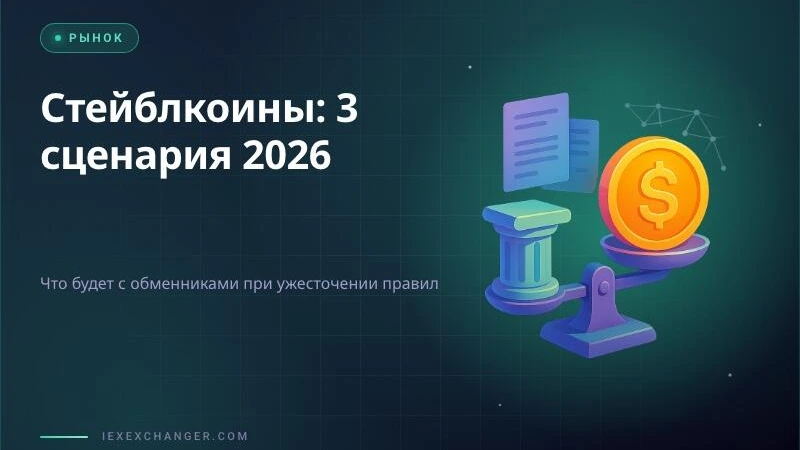
Stablecoin regulation in 2026 is no longer a hypothetical — several major jurisdictions now require a license to issue or handle these tokens, and exchangers are scrambling to adjust reserves and KYC on the fly. If you run one, this isn't background noise: whichever scenario wins determines how much of your compliance stack you'll be rewriting this year.
What's actually happening with stablecoin regulation right now
Short version: there's no single global standard, and there won't be one anytime soon. The EU's MiCA framework, in force since 2024, requires issuers of asset-referenced and e-money tokens to get licensed, hold supervised reserves, and publish regular reports. The US followed in 2025 with a federal framework for payment stablecoins that mandates 1:1 reserves and monthly attestations. Elsewhere — from offshore hubs to parts of Asia — the rules are looser, or effectively absent.
For an exchanger, that means one ticker isn't one rulebook. The same USDT or USDC can sit under wildly different requirements depending on where the issuer is domiciled and where your customer actually lives.
Scenario 1: strict licensing becomes the norm everywhere
If this plays out, stablecoin issuance concentrates in the hands of a small number of licensed players — the pattern already visible in the EU. Smaller, opaque issuers either get licensed or get frozen out as exchanges and payment partners quietly stop supporting them.
For an exchanger, that's more relief than headache: fewer stablecoins to vet means each one is easier to check. The entry price goes up, though — audits, reporting to payment partners, and documented proof of funds stop being optional extras and become part of the job.
Scenario 2: disclosure instead of licenses
The softer path has regulators demanding public reserve attestations and transparency without full licensing regimes. The market stays more varied here — niche stablecoins survive alongside the big names.
The catch: you can't lean on "it's licensed" as a shortcut anymore. You have to actually judge the quality of each attestation report yourself. In practice that means revisiting your supported-stablecoin list on a schedule — the way a bank reviews counterparties every quarter, not once and forget it.
Scenario 3: every jurisdiction runs its own playbook
The most likely outcome over the next year or two is fragmentation. The EU holds a hard line, the US builds out its federal framework, parts of Asia regulate selectively, and offshore zones stay a loophole. For an exchanger serving customers across borders, that's not one compliance system — it's several running in parallel.
The question stops being "is this a good stablecoin" in the abstract and becomes "does this token work for this customer, in this jurisdiction." Some owners will find that exhausting. Others will treat it as a moat — because not every exchanger is willing to build that level of precision.
What this means for your reserves, KYC and compliance today
Prepare for more than one scenario at once. Start with this checklist:
- the license status and jurisdiction of every stablecoin issuer sitting in your reserve;
- the date of the last reserve attestation — anything older than a quarter is a warning sign;
- your liquidity provider contracts — do they actually address who eats the loss on a depeg or a frozen token;
- your KYC thresholds — do they match the countries your customers actually come from, not just where you're registered.
Spreading your reserve across two or three stablecoins from different issuers cuts the damage if one of them suddenly gets restricted in a specific market.
Mistakes exchanger owners keep making
Most of the trouble is predictable, and it repeats from one exchanger to the next.
- Parking the entire reserve in a single stablecoin — convenient, until that one token gets hit with a regulatory restriction.
- Checking an issuer's license once, at onboarding, and never revisiting it.
- Copying a competitor's KYC policy instead of looking at where your own customers actually live.
- Ignoring local rules in low-volume markets — those are exactly the ones that produce nasty surprises later, because nobody's watching closely until they suddenly are.
Conclusion
None of the three scenarios will play out in a pure form — reality will likely be a blend: stricter in some regions, looser in others, fragmented overall. But one thing is already clear: stablecoin regulation in 2026 is only picking up speed, and an exchanger that wants to come out the other side intact should be building flexibility into reserves, KYC and its whole business architecture now. Adapting to new rules is a lot easier on infrastructure built for it — a platform like iEXExchanger lets you update an exchanger's setup without rebuilding it from scratch.