
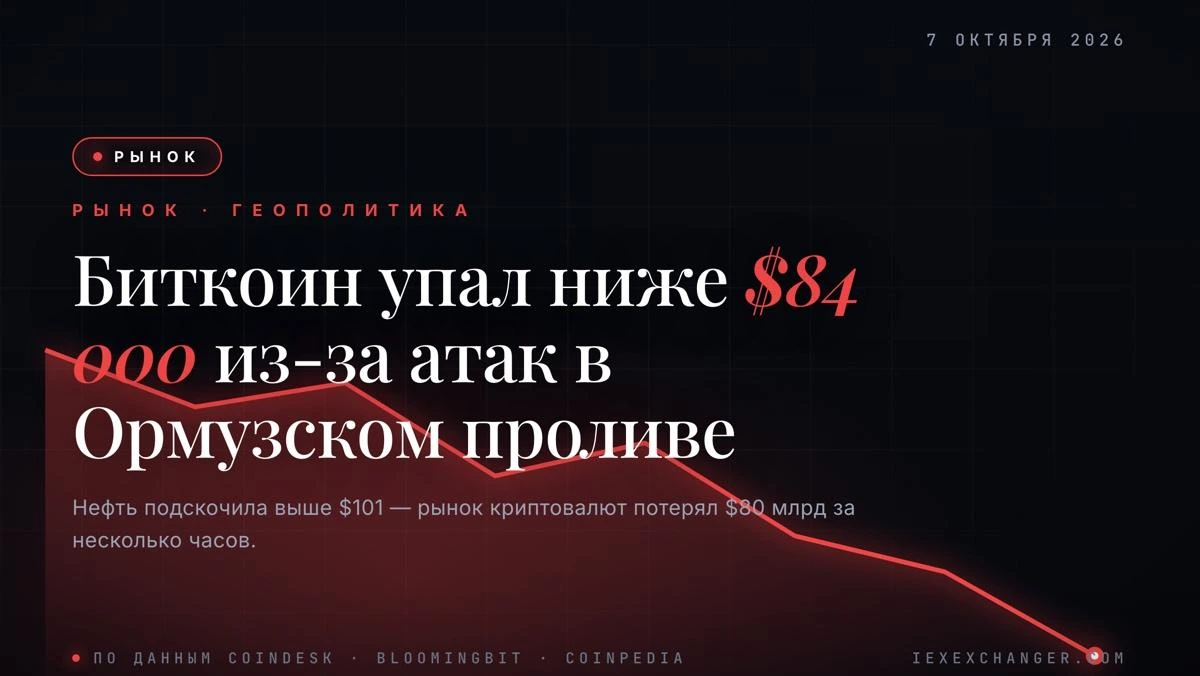
Bitcoin shed nearly 2% over 24 hours, sliding to an intraday low of $83,570 — a level the market hadn't touched since late September. This time the trigger wasn't a Fed statement or a new regulation. It came from the Persian Gulf: Iran sharply escalated drone and missile attacks on oil tankers in the Strait of Hormuz. According to the UK Maritime Trade Operations agency, at least nine commercial ships have been hit in the first week of October alone.
Oil markets reacted instantly. Brent crude jumped above $101 a barrel, a price not seen in months. Treasury yields followed, with the 10-year climbing to roughly 5.25-5.31%, while the dollar strengthened against every G10 currency. For risk assets, that combination is close to a worst-case scenario: expensive oil stokes inflation fears, and a stronger dollar paired with higher yields pulls capital out of crypto and growth stocks alike.
Bitcoin had been trading near $86,600 just a day earlier and had already failed, for the third time since late September, to break through resistance around $87,000. Once the Hormuz escalation hit the wires, the price punched through the psychologically important $84,000 level. FXPro analysts noted that a break below that mark could signal bears taking control. Altcoins slid in sympathy: ether lost 3.5%, XRP fell about 3%, and Dogecoin dropped nearly 5%.
Leveraged traders took the brunt of it. Exchanges liquidated roughly $549 million in positions over 24 hours, hitting more than 100,000 accounts — 88% of them long bets on higher prices. The crypto market's total capitalization shrank by about $80 billion within hours.
The Strait of Hormuz is a narrow chokepoint carrying roughly a fifth of the world's seaborne oil, and markets tend to react to any threat there on reflex, regardless of how much oil actually fails to reach buyers. For crypto, it's a reminder that bitcoin, despite the "digital gold" framing, still trades like a conventional risk asset during geopolitical stress — moving with stocks, not against them.
The next test is whether the $83,000 support line holds. A break below opens the door toward $80,000, while bulls need a recovery above $86,000-$87,000 to keep this looking like a dip rather than a trend reversal.