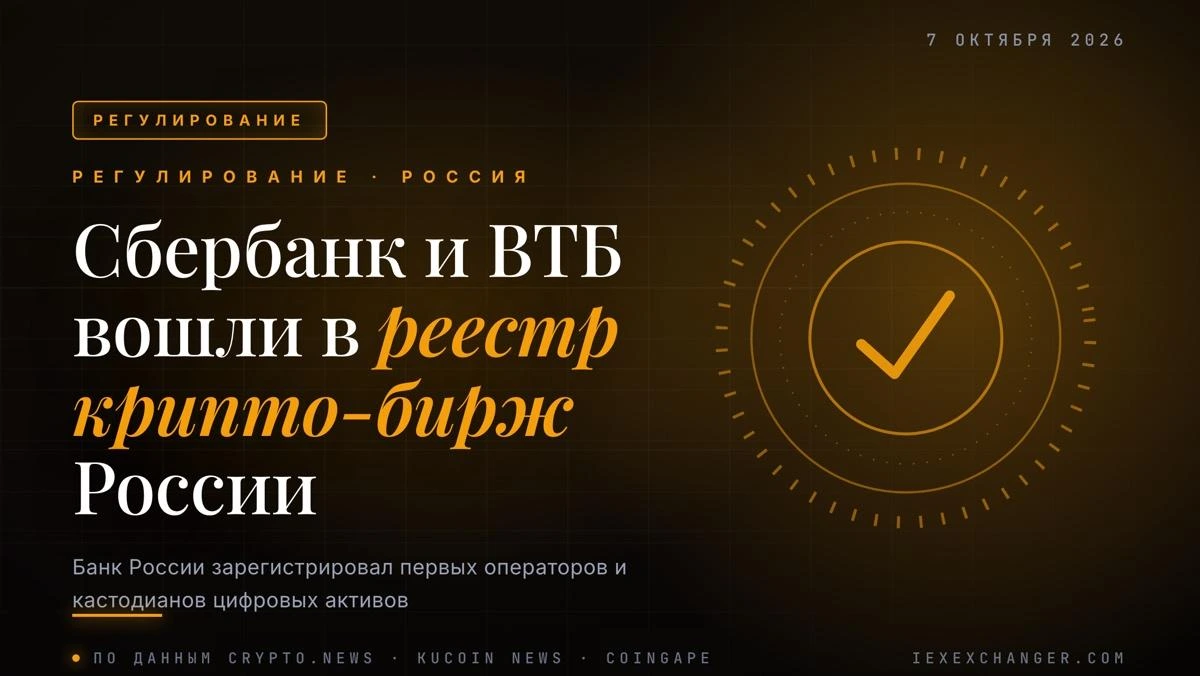
The Bank of Russia has published its first official registry of companies allowed to handle cryptocurrency inside the country. VTB, Zefir, Sistema Crypto and T Invest Lab made the list as exchange operators, while Sberbank, VTB, Atomyze, Voltari and Cloud Infrastructure were registered as digital custodians.
The move follows a digital currency law President Putin signed in August, with the regulatory regime itself taking effect on September 1. Before that, crypto in Russia lived in a grey zone — mining and holding coins was never illegal, but trading through banks and licensed platforms simply wasn't possible.
Retail investors without qualified status can now buy no more than 300,000 rubles' worth of crypto a year through any single intermediary, and only after passing a risk-comprehension test. Qualified investors face no cap, though the test is still mandatory for them too.
Sberbank, already registered as a custodian, says it will open bitcoin, ether and USDT trading and storage to customers on December 1. That would make it the first systemically important Russian bank to offer crypto services to ordinary retail clients rather than a handful of institutional players.
The contrast with Washington is hard to miss: a comparable bill, the CLARITY Act, has been stuck in the US Senate for months. Russia chose a different route, building its crypto market through a top-down decision from the central bank and state-owned lenders rather than market consensus. Whether international crypto infrastructure will want to deal with exchanges supervised by a sanctioned bank like Sberbank remains an open question.