
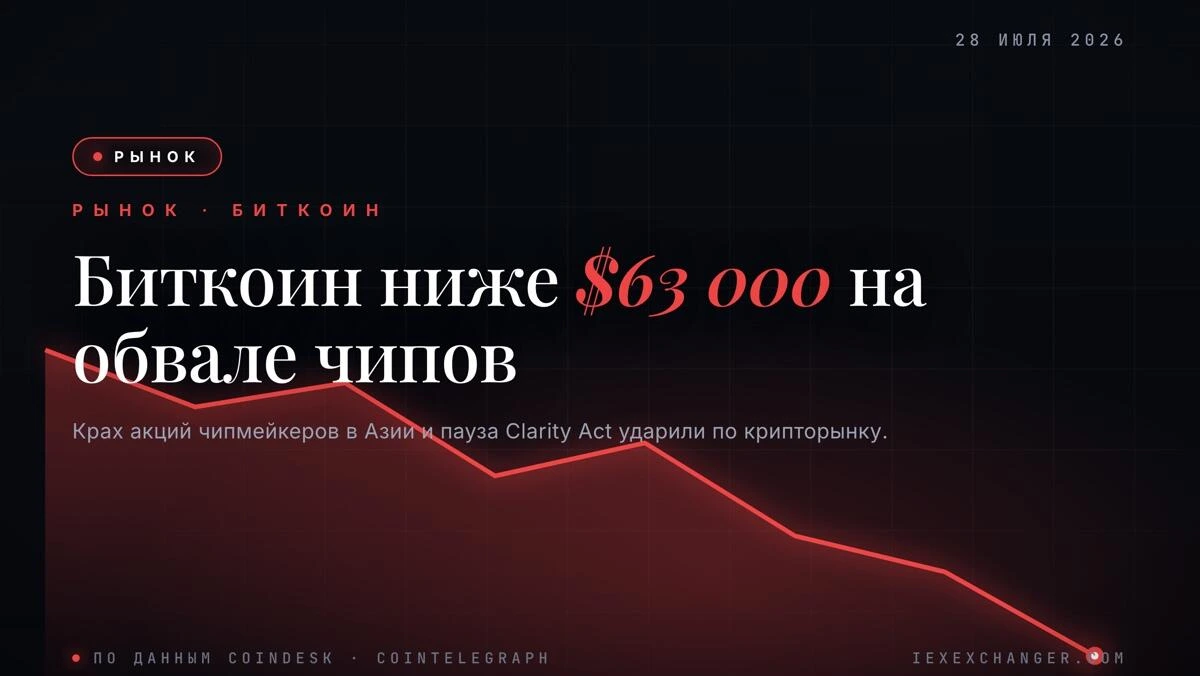
Bitcoin briefly slipped below $63,000 on Tuesday, its lowest level in ten days. The trigger had nothing to do with crypto itself: South Korea's Kospi index plunged nearly 11% in a single session, one of its worst drops in years, as chipmaker stocks got hammered across the region. SK Hynix lost almost 15%, Japan's Kioxia fell 18%, and US-listed Micron dropped more than 10% at the open, sliding back to levels last seen in May. The Nasdaq slipped more than a percent in sympathy.
Behind the selloff sits a growing unease about trillion-dollar AI spending. Alphabet, Microsoft, Amazon and Meta are together tracking toward roughly $725-730 billion in 2026 capital expenditure on AI infrastructure, with 2027 estimates climbing toward $900 billion. Investors are increasingly asking whether that spending will actually pay off, and once the doubt reached chipmakers, it spilled into every risk asset in sight, crypto included.
Ether failed to hold the psychological $2,000 level and slid to around $1,880, while bitcoin, despite bouncing back to roughly $63,600, still shed a meaningful chunk of value on the day: exchanges force-closed nearly $510 million in long positions over 24 hours. On Hyperliquid, a perpetual contract tracking SK Hynix briefly flash-crashed to $900 — a rare instance of panic in traditional markets breaking crypto derivatives too.
Adding to the jitters, the US Senate effectively shelved the CLARITY Act, the crypto industry's central market-structure bill, pushing it toward autumn. Majority Leader John Thune said the bill won't reach a floor vote before the chamber's summer recess begins in early August, with a Russia sanctions package and judicial nominations taking priority instead. The formal sticking point is restrictions on crypto holdings by government officials — an issue that looked nearly resolved three weeks ago after Trump conceded ground on ethics language. Now the bill's fate this year is genuinely uncertain again, and with midterm elections looming this fall, the odds of passage keep shrinking.
All of this landed right as the Federal Reserve opened a two-day meeting Tuesday, with markets pricing in roughly a 35% chance of a rate hike. That overlap — a chip-stock rout, a stalled bill and a Fed decision, all in the same 48 hours — is why crypto is reacting harder than any single piece of bad news would normally justify.