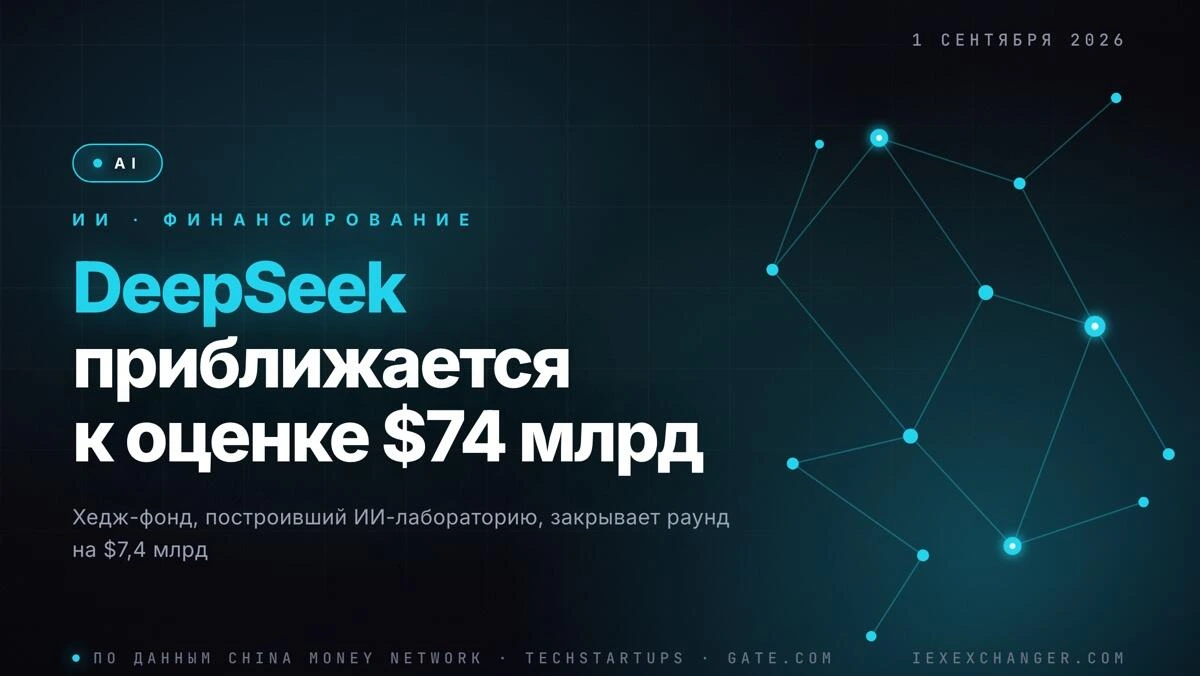
DeepSeek's valuation has jumped by roughly half in two months. Back in June, investors including Tencent priced the Chinese AI lab at more than $50 billion. Now, according to China Money Network and several other outlets, the company is closing in on a $7.4 billion raise — about 50 billion yuan — at a $74 billion pre-money valuation, pushing the post-money figure to roughly $81 billion once the round closes near the end of August.
Existing backers Monolith Management, Shixiang Capital and battery giant CATL are joined in talks by CPE, Legend Capital, Stony Creek Capital, GigaDevice-linked funds and state investment vehicles from Hefei. The cash is earmarked for roughly a gigawatt of additional compute to train bigger models, plus retaining engineers in a brutal domestic hiring war.
DeepSeek didn't start as a typical startup. It grew out of High-Flyer, the quant hedge fund founded by Liang Wenfeng, which bankrolled the lab's early models and compute clusters. People familiar with High-Flyer's finances say the fund's own trading revenue has grown unpredictable, pushing the AI arm to raise outside money at this scale for the first time. DeepSeek's annual recurring revenue sits around $500 million — a gap between sales and valuation that now looks normal across the entire AI industry, not unusual to DeepSeek alone.
The company is preparing a possible listing on Shanghai's STAR Market, with a filing as early as late 2026 and a debut targeted for 2027 — a domestic route that sidesteps the geopolitics OpenAI and Anthropic face pursuing US listings. Meanwhile DeepSeek and its parent fund are branching into other bets: High-Flyer affiliates put $26 million into pre-IPO shares of chipmaker CXMT, and DeepSeek itself holds a 2.31% stake in Unitree Robotics under a three-year lockup.
The round lands as Chinese AI labs — DeepSeek included, alongside Alibaba, Tencent and Zhipu — raise API prices in near unison. The price war that crushed margins across the industry in 2025 looks to be winding down, if only because gigawatt-scale power and chip bills don't leave much room for discounting.