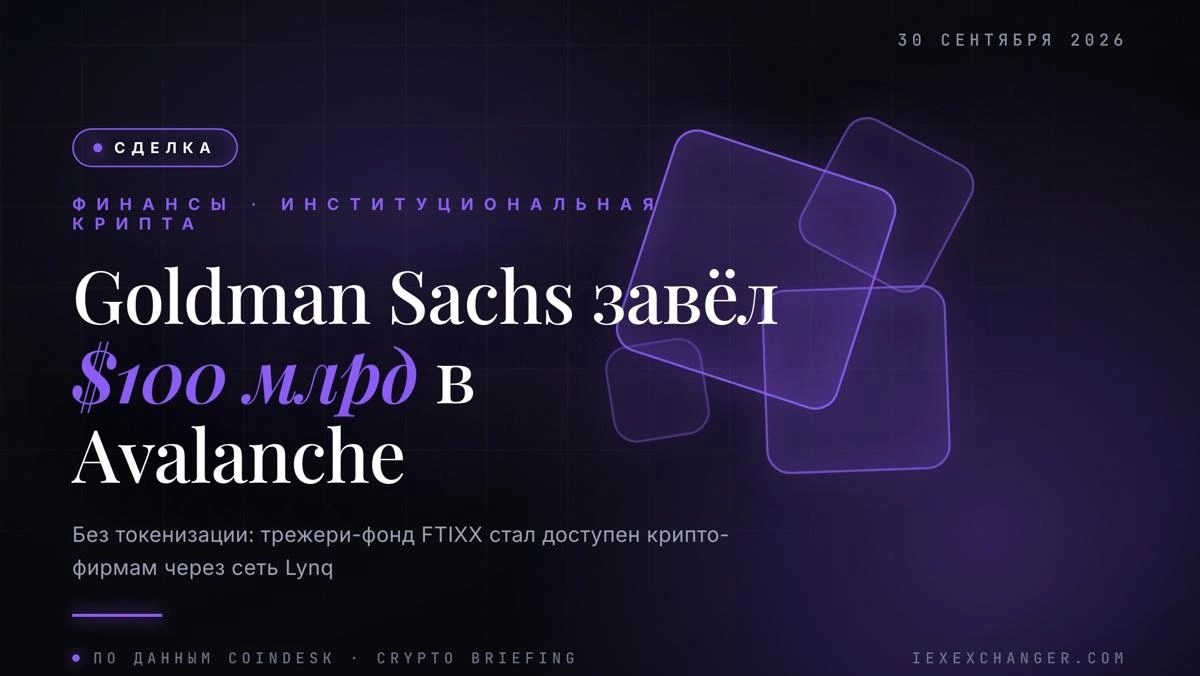
Goldman Sachs runs a $100 billion Treasury fund. Crypto trading firms have a mundane problem: spare cash sitting between trades usually just parks on an exchange account, earning nothing. The bank just connected those two facts — and picked Avalanche, not Ethereum, to do it.
The Financial Square Treasury Instruments fund, ticker FTIXX, is now reachable through Lynq, a settlement network built by Arca Labs, Tassat Group and tZERO on a private version of Avalanche. More than 30 institutional crypto firms have access, including market makers B2C2 and Wintermute, broker FalconX, custodian Fireblocks, exchange Crypto.com and investment firm Galaxy. Trades run through tZERO Securities, an SEC-registered broker-dealer, and access is limited to vetted U.S. institutional clients.
There's a detail here that sets this apart from the usual "Wall Street tokenizes everything" headlines. BlackRock turned its BUIDL fund into a token on Ethereum; Franklin Templeton did the same with BENJI — shares of those funds literally live on-chain and can move between wallets. Goldman took a different route: FTIXX stays a conventional fund, and Avalanche is used purely as a settlement rail. Nothing changes legally, but the bank sidesteps the token-classification and custody questions regulators still haven't fully answered.
For trading firms, this solves a real annoyance. Idle cash between trades used to either sit dead in an exchange account or get parked in a non-yielding stablecoin. Now it can sit in a Goldman Treasury fund for a few hours or days and come back out through blockchain settlement instead of a wire transfer that can take a full day. The market reacted fast: AVAX jumped more than 11% intraday, as investors read the deal as a sign that big banks are building permanent rails on the network, not just running a one-off pilot.
The scale is still tiny: Lynq's entire platform holds roughly $89 million in assets — a rounding error next to a $100 billion fund. That points less to a mass migration of capital than to a bank testing a channel that could grow alongside institutional demand for crypto-native settlement. For Avalanche, Goldman's presence is a far bigger trust signal than the fund itself is for Goldman, where FTIXX is just one product among many.