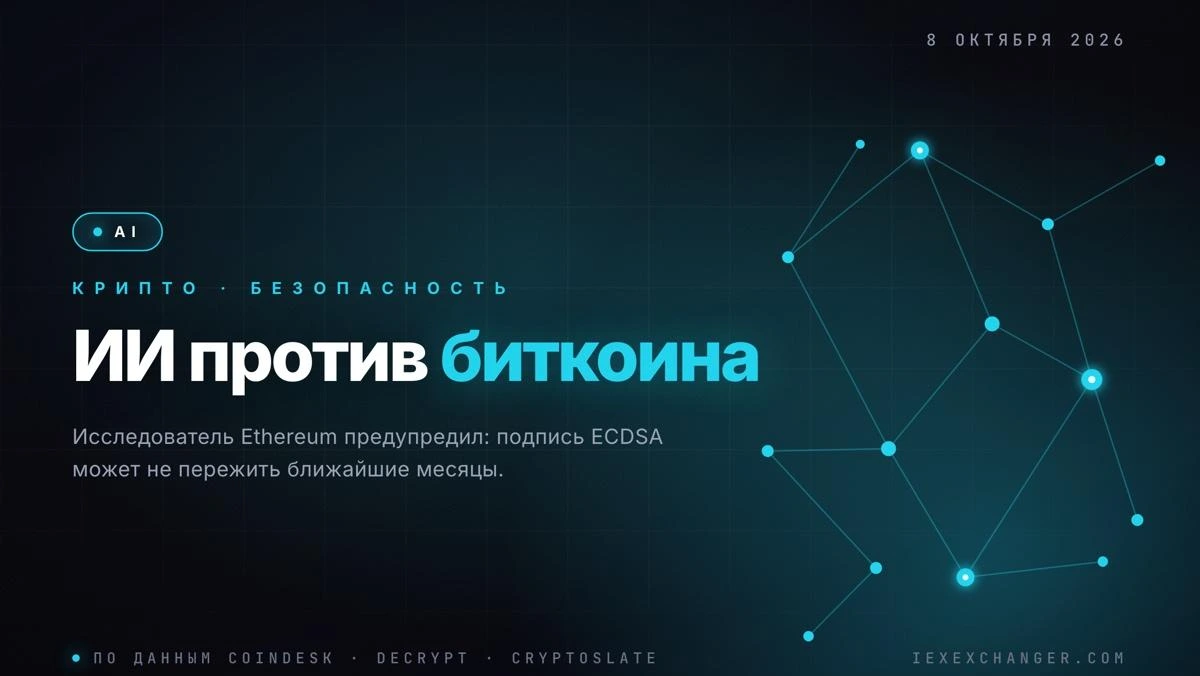
A post from Ethereum Foundation researcher Justin Drake pulled in nearly 4 million views this week, and it wasn't about price. Drake is telling the industry to start preparing for what he calls "bunker mode" — a slow, careful migration of bitcoin and ether to fresh addresses whose public keys have never touched the blockchain. The trigger isn't the usual quantum-computing scare. It's artificial intelligence.
Drake points to 722 math results OpenAI recently published as proof that assumptions long treated as safe are starting to crumble. His worst-case read: the elliptic curve signatures securing bitcoin and ether wallets could fall "in months, not years," with a private key recoverable from a public one in about a week on a large GPU cluster. The addresses most exposed right now are roughly 20,000 early wallets tied to Satoshi Nakamoto, each holding 50 BTC mined in the network's first months, all with public keys long since exposed on-chain.
Vitalik Buterin isn't dismissing the warning — the Ethereum Foundation already runs a dedicated post-quantum security team. But he's telling holders not to rush their own migrations, recalling that he lost funds himself in a botched move years ago. He added an uncomfortable twist of his own: even lattice-based cryptography, the stuff billed as quantum-proof, could "take serious hits from the next two years of AI math." Not everyone buys the premise — Jan3's Samson Mow called the whole scenario overblown.
Bitcoin slid from near $86,600 on Tuesday to around $82,300–$82,800, with the CoinDesk 100 down close to 2% over 24 hours — though rising bond yields and a jump in oil prices did their share of damage too. Algorand, marketed as quantum-resistant, jumped 9%. Zcash, a privacy coin, dropped 6%.
Nothing here proves AI can already break ECDSA — this is one researcher's worst-case estimate, cautiously echoed by another. What it does show is that exchanges and wallet providers are now debating a rebuild of fund security on a timeline measured in months, not the decade-plus runway the industry assumed it had for quantum risk alone.