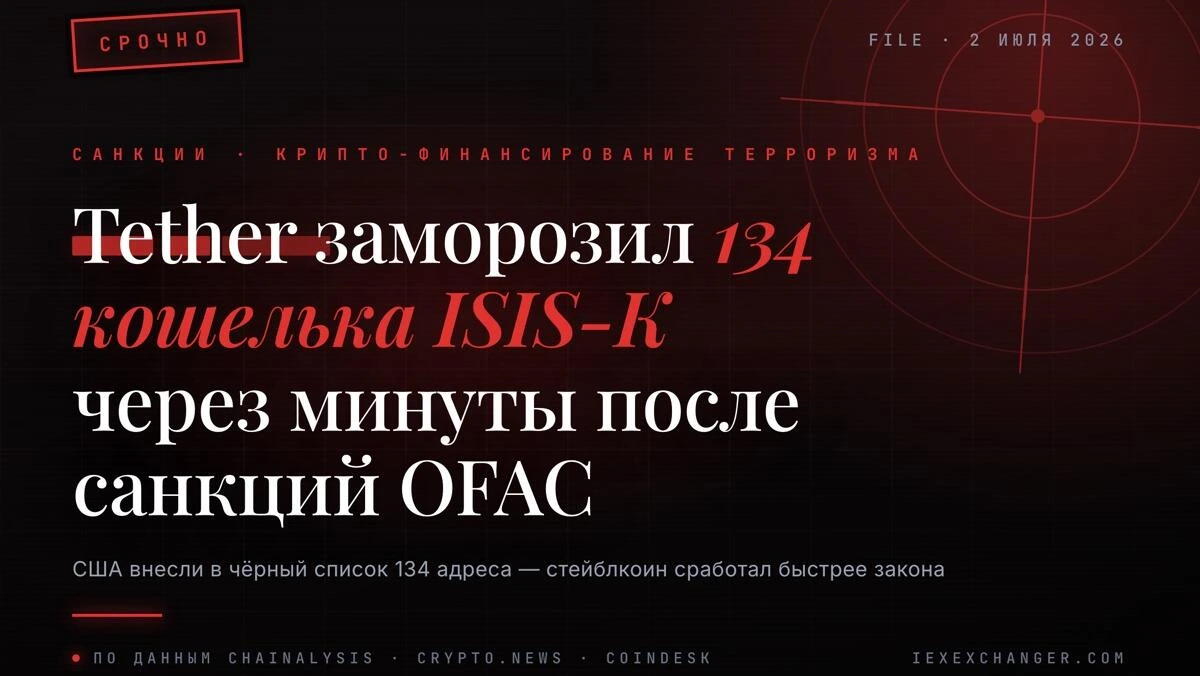
The US Treasury's enforcement arm moved with unusual speed. On July 1, 2026, OFAC updated its designation of ISIS-K — the Islamic State's Afghanistan-Pakistan branch — by adding 134 cryptocurrency addresses to its Specially Designated Nationals list. Within minutes, Tether had frozen every USDT balance across 131 of those addresses on the TRON network.
The wallets belong to ISIS-K's media arm, the al-Azaim Foundation, which has used crypto donations to fund operations for years. Since 2023, these accounts received about $1.4 million in incoming transactions and moved roughly $880,000 outbound. The sums are modest — but small, fragmented flows invisible to conventional banks are precisely how groups like ISIS-K fund recruitment, propaganda, and logistics without triggering traditional wire-transfer alerts.
The three Monero addresses on the list are a different matter entirely. OFAC can designate them, but no one can freeze them. Monero has no issuer, no kill switch, no corporate intermediary to comply with a government order. Transactions and balances are cryptographically hidden, and the network is fully decentralized. Listing a Monero address is purely symbolic — and it draws a precise boundary between where state power over crypto ends and where privacy-coin architecture begins.
Chainalysis flagged all 134 addresses immediately in its compliance products, tools used by exchanges and payment platforms worldwide. Any platform running standard AML checks will now receive an automatic alert if users interact with those wallets.
The same day brought a separate enforcement action: two Brazilian nationals and four affiliated companies were sanctioned for laundering approximately $30 million through cryptocurrency on behalf of the PCC drug cartel. Two actions in a single day, across two continents.
Both cases sharpen the same question: if a stablecoin issuer can neutralize sanctioned funds in near-real-time, how much of the "permissionless" promise actually remains? And how far will regulators push this coordination before the boundary between public enforcement and private infrastructure disappears entirely?