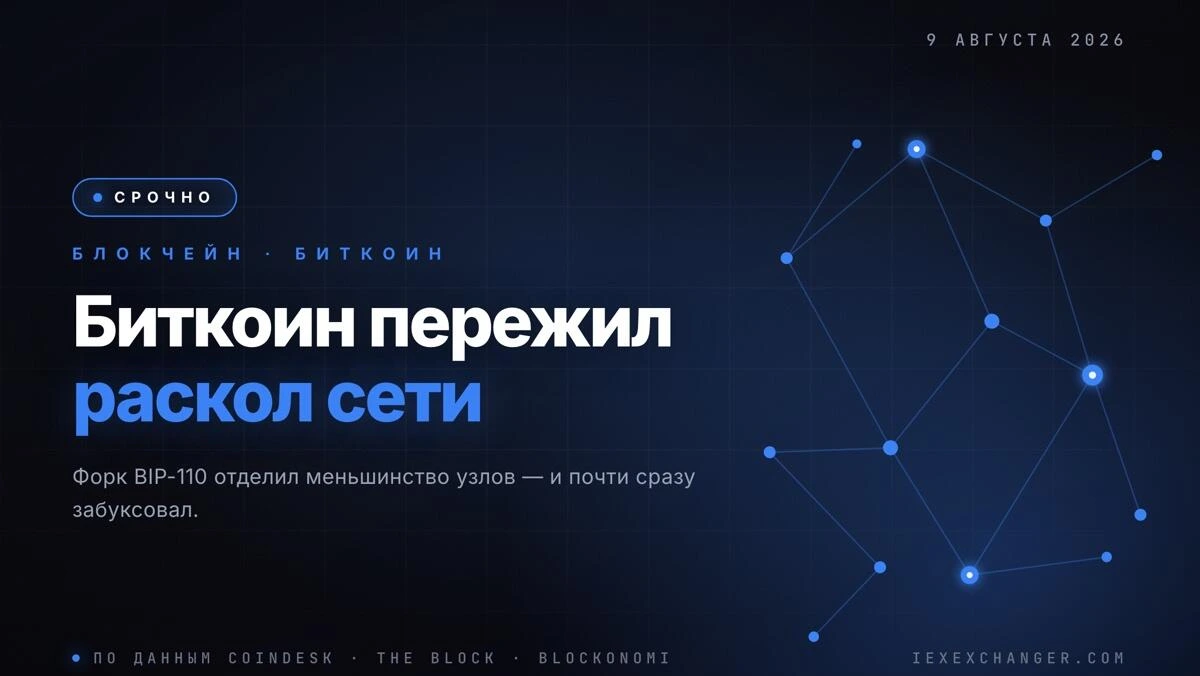
For a few hours on August 9, bitcoin wasn't one network. A slice of miners and nodes enforcing the contentious BIP-110 upgrade broke off from the main chain — and stalled almost immediately, producing just two blocks in eight hours while the dominant chain raced dozens ahead.
BIP-110, the "Reduced Data Temporary Softfork," would have banned embedding non-financial data — images, text, arbitrary files behind ordinals and inscriptions — in bitcoin transactions for a year. Backers argued it would free up block space and cut fees for people actually sending money. Opponents, including bitcoin advocate Michael Saylor, countered that anyone who pays the fee has bought the right to use that space however they like, and that miners and node operators have no business policing which transactions count as legitimate.
The proposal never came close to the support it needed. Over the prior 2,016-block period, only 51 blocks — 2.53% — signaled backing, far short of the 55% threshold required to lock in without a split. A minority of nodes enforced the rule anyway. At block 961,632, AntPool mined a block without the required signal; BIP-110 nodes rejected it and followed an alternative block relayed through OCEAN by the pool Roughnecks. For a few hours, bitcoin quite literally had two competing histories.
The breakaway chain's problem showed up fast: it inherited bitcoin's full mining difficulty while controlling under 3% of hashpower. Instead of a block every ten minutes, it's producing one every few hours, and it can't retarget difficulty until it completes 2,016 blocks — roughly 350 days at this pace, versus the usual 14. Worse, BIP-110's own rules require every block up to height 963,647 to keep signaling; at the current crawl, the minority chain has no realistic shot at getting there.
Nothing changes for bitcoin held on exchanges or in ETFs — no major venue backs the breakaway chain, so those coins stay on the dominant network. Self-custody holders, particularly those running Bitcoin Knots, face a real risk: the new chain still lacks replay protection, so a signed transaction can go through on both chains at once. Sell "fork coins" and someone could rebroadcast that same signed transaction on the main chain — and walk off with your real bitcoin.
Bitcoin Core never adopted BIP-110, and nearly all of the network's hashpower is still following the old rules. Still, a live split like this is rare — the last time a fight over what belongs in the blockchain actually broke off a separate chain was nearly a decade ago. BIP-110's fate should be clear within a couple of weeks: either the minority chain picks up steam, or it quietly dies out.