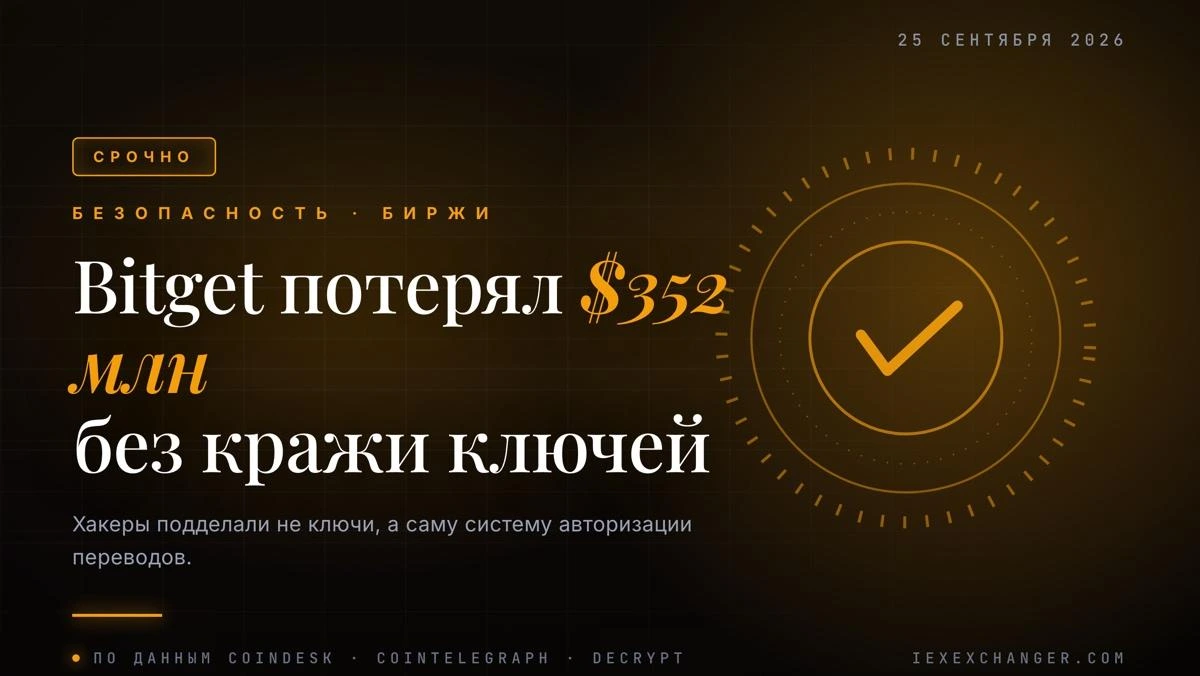
It took less than an hour for hackers to drain roughly $352 million from crypto exchange Bitget — and they didn't need to steal a single private key to do it. On September 24, Bitget flagged unusual outflows from its hot and warm wallets and froze operations while it figured out what had gone wrong.
The method was more surgical than a typical wallet break-in. According to CEO Gracy Chen, attackers slipped into a backend system that manages the exchange's wallets, faked transaction data, and tricked the authorization process into waving the transfers through as if they were legitimate. Chen likened it to forging withdrawal slips and sliding them through a bank's own teller window — the signature is fake, but the cash that walks out the door is real.
XRP holders took the biggest hit: roughly 103 million tokens, worth about $157 million, vanished — nearly half of everything stolen. Close behind was almost 32,000 ETH (about $86 million), tens of millions of dollars in USDT and USDC, a slice of tokenized gold (XAUt), plus BNB, AVAX and TRX. The attackers wasted no time converting much of the haul into ether through a freshly created wallet, buying roughly 68,000 ETH on the open market — traders noticed the price spike in real time.
Bitget's cold storage was never touched; the breach stayed confined to hot and warm wallets. Withdrawals are paused 'as a precaution,' though deposits and trading continue as normal. The company says no customer will lose money: its User Protection Fund, which holds more than $464 million, is large enough to cover the entire loss on its own.
Chen also said some of the attackers' IP addresses matched VPN services previously tied to a North Korean hacking outfit, though she cautioned the attribution is preliminary. If it holds up, Bitget joins Bybit, which lost $1.4 billion in a strikingly similar attack in February 2025 that the FBI pinned on North Korea's Lazarus Group. The bigger lesson for the industry: cold storage isn't the only thing worth hardening. As Bitget just found out, an authorization system can be tricked into approving a transfer without anyone ever touching the actual keys.