A multisig wallet for a crypto exchanger isn't paranoia — it's basic hygiene. Every day your exchanger keeps an operating reserve in a hot wallet. One compromised key and the funds are gone in minutes. Here's how multisig works and which schemes real exchangers actually use.
Hot Wallets: The Convenience You Pay For
A hot wallet is always connected to the internet. That makes it fast — transactions go out instantly, automation runs without operator input. It also makes it a target.
The private key lives on a server. If an attacker gets into your server, your database, or your hosting account, they have the key. Everything on that wallet is already theirs. Most exchanger hacks work exactly this way: they don't crack the blockchain — they find the single key. Whether that wallet holds $5,000 or $50,000, the mechanics are identical. Only the loss differs.
What Multisig Is — Without the Jargon
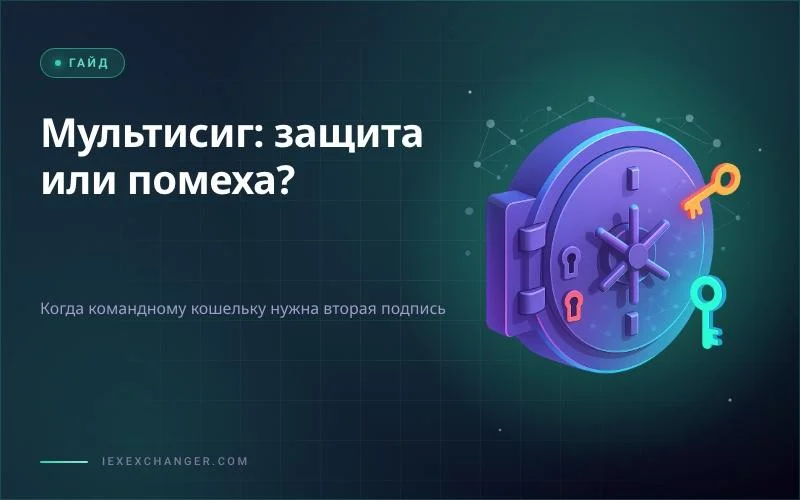
A multisig wallet requires several keys at once to sign a transaction. Think of a safe with two locks: one key with you, one with a partner. Neither key opens the safe alone.
The format is written as M-of-N: out of N keys, at least M must sign. For example, 2-of-3 means there are three keys, and any two can authorise a transaction. This is the most common setup for small and mid-sized exchangers.
The key point: even if one key is stolen or lost, the funds stay safe. An attacker would need to compromise several independent storage locations at the same time.
Schemes That Actually Work for Exchangers
The right setup depends on transaction volume and team size. Three options you'll see in practice:
- 2-of-2 (two keys, both required). One key on the server, one with the owner on a separate device. The simplest protection against server compromise. Downside: if the owner's device is unavailable, the exchanger stops.
- 2-of-3 (three keys, any two required). One key on the server for automation, one with the operations manager, one in cold storage as backup. Best balance of convenience and security. The most common real-world scheme.
- 3-of-5 (five keys, three required). For larger exchangers with a team. Keys distributed across several people and devices. Keeps running even if two participants are unavailable.
For most mid-sized exchangers, 2-of-3 hits the sweet spot. Automation runs on the server-plus-manager pair; the backup key stays offline.
When Multisig Is Overkill
Honest answer: if you're just launching and amounts are small, jumping straight to 3-of-5 is spending time on setup you don't need yet. A solid 2-of-2 with a clear key-backup policy is enough in the early days.
Multisig also doesn't protect against application-layer attacks — where an attacker intercepts an already-formed transaction or substitutes a withdrawal address. That's a separate security layer: withdrawal address validation.
Three Steps to Move to Multisig
Migration doesn't mean taking your exchanger down for a day. You can do it gradually:
- Generate the multisig wallet separately. Pick your scheme (2-of-3), create keys on different devices, and test with a small transaction first.
- Move a buffer there first. Start with 30–50% of your operating reserve. Work through the process: how transactions get signed, who gets notified, what happens when one participant is unavailable.
- Migrate fully. Once the process is smooth, move the remaining balance. Keep the old hot wallet empty or close it.
The hardest part isn't technical — it's agreeing with your team: who holds which key, where are the backups, how to sign in an emergency. Write it into a policy document.
Conclusion
Multisig doesn't complicate your exchanger — it removes a single point of failure that has cost many owners their entire business. A 2-of-3 scheme gives you automation, security, and a fallback if a key is lost. This isn't some future best practice — it's the current standard for serious operations.
If you want to launch an exchanger with sound storage architecture from day one, the ready-made solution from iEXExchanger — iEXWallet — gives you your own wallet without paying a middleman commission.