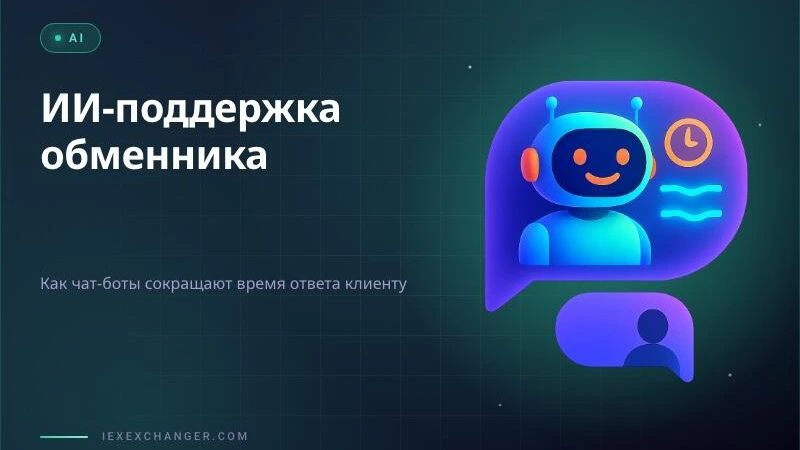
AI support chat for a crypto exchanger is a language-model-powered bot that handles the first line of client contact: order status, live rate, limits, and routine verification questions. It doesn't replace a human agent — it strips away the repetitive work and answers in seconds, not the two minutes it takes an impatient client to open a competitor's tab instead.
Why response speed beats the rate itself
Clients rarely shop exchangers by a tenth of a percent in fees. They shop by who answered first and made sense. Exchanger traffic peaks at night, on weekends, and during sharp volatility — exactly when a human agent is tired, asleep, or buried in tickets, while an automated competitor answers just as fast at 3 a.m. as at noon.
One unanswered question in the middle of the night, and a large order goes wherever someone actually replied. That's not a hypothesis — it's ordinary churn mechanics. Nobody waits for “the next available agent” when a one-click alternative sits right there.
What an AI chat can genuinely handle
A well-configured bot absorbs the routine that eats most of an agent's shift:
- tracking the status of an existing order;
- calculating the payout amount at the current rate and fee;
- answering standard questions on verification, limits, and payment methods;
- covering several languages at once without hiring a separate agent per language;
- escalating instantly to a human the moment a request falls outside its script.
In practice, the bot is a filter: 70-80% of conversations in any exchanger are routine, and those are exactly what's worth automating first.
Where AI breaks down — and a human still has to step in
A disputed order, a complaint about a delayed transfer, suspected fraud, or an unusual verification document — here the model shouldn't improvise an answer, it should hand the conversation straight to an agent. That's not a technology weakness, it's a safety requirement: the call on disputed money has to stay with a person who's accountable for it.
There's a second risk, too — social engineering. A scammer posing as a client may try to talk the bot into a non-standard action. A solid escalation script needs to catch those attempts on trigger keywords, not rely on the model's “common sense.”
How to choose an AI assistant for exchanger support
Before hooking up the first tool you find, check it against a short list:
- integration with your internal order system and live rates, not a static price list;
- a clear, configurable escalation path to a human agent;
- full conversation logging — useful for compliance and for reviewing disputes later;
- the ability to restrict tone and scope so the bot never promises something the exchanger doesn't guarantee;
- support for the actual languages your clients write in.
Common mistakes when rolling it out
The most dangerous one: giving the bot full autonomy on disputed orders “for speed.” A close second: launching it and forgetting about it — without regular log reviews, scripts go stale and new client questions go unanswered. And third: never testing the escalation flow, so in a real conflict the bot just loops instead of calling a human.
Conclusion
AI chat doesn't replace an exchanger's support team — it absorbs routine questions and frees agents for the cases that actually need human judgment. For an exchanger owner, this isn't a one-off feature but part of the service infrastructure, worth rolling out deliberately with clear escalation boundaries. A ready-made client support solution for exchangers is iEXChat.