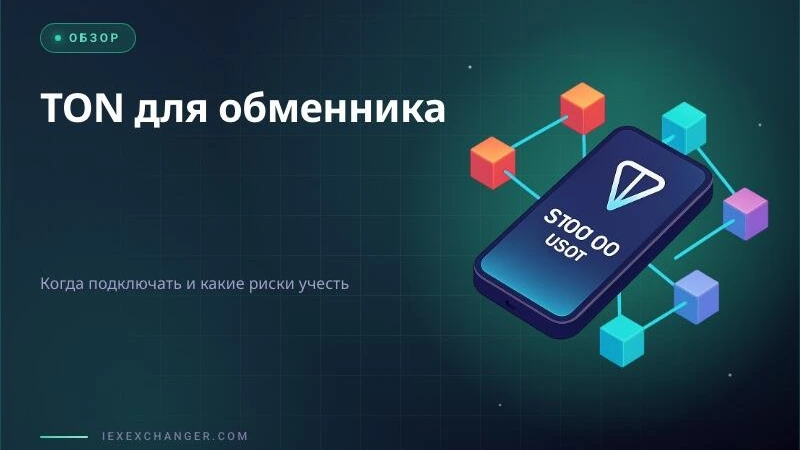
TON blockchain for crypto exchangers has moved from speculative territory into a real business decision — faster than most expected. USDT runs on TON, Telegram Wallet puts it in the hands of hundreds of millions of users, and exchanger operators face a concrete question: does connecting TON actually benefit my business? The honest answer depends on who your clients are and how you handle risk.
Why TON Landed on Everyone's Radar
The Open Network was originally a Telegram project; today it is stewarded by the independent TON Foundation. But Telegram still provides the network's biggest edge: a built-in Wallet inside the app. Users store and send USDT without installing anything extra — from the same messenger they use every day.
For an exchanger, that is not abstract opportunity. If your clients are on Telegram — and they almost certainly are — TON creates a frictionless path: client sees the payment details, sends USDT from Wallet, transaction confirms in seconds. No extra steps.
Fees and Speed: What Actually Matters
Sending USDT on TON costs fractions of a cent, and confirmations take 5–10 seconds. On these metrics, TON matches Tron (TRC20), which has long been the benchmark for cheap-and-fast USDT transfers.
But comparing fees alone is a mistake. Tron is a mature market — dozens of exchanges, hundreds of exchangers, deep liquidity in TRC20 USDT pairs. TON is a growing ecosystem: smaller volumes, more limited market depth. On larger trades, the spread difference can be noticeable.
TON vs Tron: An Honest Comparison for Exchangers
These two often get lumped together as the cheap-and-fast USDT options. In practice, they are different bets.
- Tron (TRC20) — mature infrastructure, maximum liquidity, the familiar choice for clients coming from Binance and similar exchanges. One caveat: the network is popular in grey-market flows, so many AML systems scrutinize TRC20 addresses closely.
- TON — younger market, growth driven by Telegram's audience, low fees. Key difference: AML monitoring tools for TON are newer and cover a smaller pool of historical transaction data.
The practical read: TON and Tron are not rivals for an exchanger — they complement each other. Already running TRC20? TON expands your audience, it replaces nothing. Just starting? TRC20 USDT is the sensible first move; TON comes second or third.
Three Risks That Reviews Usually Skip
AML gaps. Ethereum and Tron have years of transaction history behind mature analytics services. TON is newer — coverage is thinner. If your exchanger must screen addresses, verify with your provider how thoroughly they handle TON.
Address formats. TON uses two address variants — raw (technical) and user-friendly (with a bounce/non-bounce flag). Mishandling this is a real path to lost funds. It is solvable, but demands careful implementation.
Market depth. On trades above a few thousand dollars, spreads in TON liquidity pools can differ meaningfully from Tron markets. Test real quotes at your actual volumes before going live — do not rely on theoretical fees alone.
When to Add TON — and When to Wait
Adding TON makes sense now if:
- Your clients are active Telegram users — Wallet is already in their pocket;
- You are building or planning a Telegram Mini App for your exchanger;
- Your average deal size is a few thousand dollars or less, where liquidity holds up;
- You want to stand out on BestChange with niche currency directions.
Hold off if:
- Your AML provider does not fully support TON yet;
- Your exchanger engine lacks proper TON address handling;
- You serve corporate clients who need maximum liquidity depth.
Conclusion
TON is neither hype nor an experiment anymore. It is infrastructure with a genuine edge: a direct channel into Telegram's audience. For an exchanger whose clients are already there, that is a real competitive advantage. But connecting it properly means three things: verifying your AML provider's TON coverage, ensuring your engine handles both address formats correctly, and testing real spreads at your actual volumes.
If you are building an exchanger with Telegram users in mind, take a look at iEXExchanger — a ready-made Telegram Mini App solution for crypto payments directly inside the messenger.