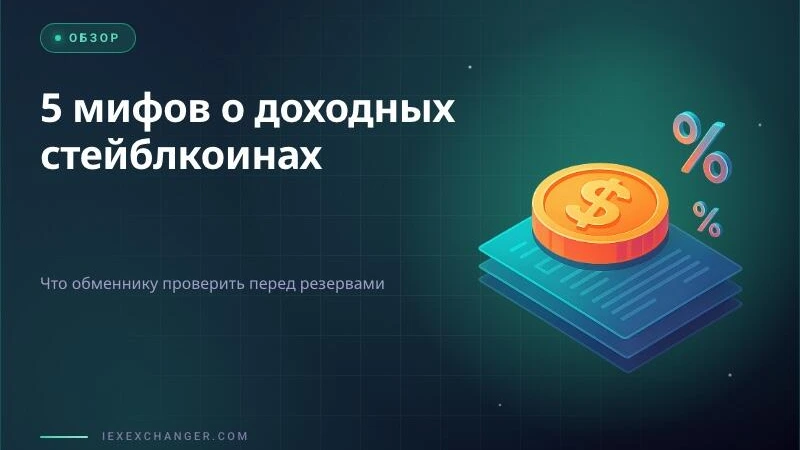
Yield-bearing stablecoins do something plain USDT never does: they pay you for simply holding the coin. It sounds like a savings account without the bank — and for anyone running an exchanger, that's exactly the question worth asking honestly. Where is the yield actually coming from, and where does it turn into a fast way to lose a client's money?
What Yield-Bearing Stablecoins Actually Are
These are dollar-pegged tokens where a slice of the issuer's reserve income — U.S. Treasuries, repo deals, sometimes DeFi strategies — flows back to whoever holds the token. Plain USDT just sits there; it earns nothing extra for the holder. A yield-bearing coin like USDe, USDY or sDAI credits that income directly, either as a growing balance or a rising token price. Think of it as an on-demand savings account, except the interest ticks almost in real time instead of once a month.
Myth 1: It's Just USDT With a Bonus
The mechanics are genuinely different, and that changes everything downstream. Plain USDT is an IOU from its issuer — hold reserves, promise to redeem at par. A yield-bearing stablecoin is often structured closer to a fund share or a derivative: you're effectively investing in a portfolio, not just parking a digital dollar. For an exchanger, that means legal classification, tax treatment and issuer risk become three separate questions instead of one.
Myth 2: The Yield Is Stable and Guaranteed
The rate almost always floats with U.S. Treasury yields or with demand inside whatever DeFi pool backs the reserves. Treasury yields ran above 5% in 2023–2024; the Fed's 2026 rate-cutting cycle has already shaved off part of that premium. Protocols that earn from funding-rate arbitrage — the mechanism behind coins like USDe — can even see yield dip into negative territory for a stretch when the market flips. There's no guarantee here, only a historical range.
Myth 3: "Stablecoin" Means No Risk
The word "stable" describes the price target, not the safety of the mechanism behind it. Yield-bearing versions stack on smart-contract risk, counterparty risk — who is actually holding the reserves — and liquidity risk, where redemption at par can queue up or pause during a panic. Remember how fast UST lost its peg in 2022, and the illusion that "stable" in the name equals a guarantee falls apart on its own.
Myth 4: Regulators Have Already Sorted This Out
The legal framework here is still patchy. The U.S. GENIUS Act, passed in 2025, explicitly bars payment-stablecoin issuers from paying interest to holders — which is exactly why yield-bearing versions tend to launch as a separate investment product or register outside U.S. jurisdiction. For an exchanger, that means disclosure requirements and compliance obligations vary depending on which country your clients actually sit in.
How an Exchanger Should Actually Decide
Before adding a yield-bearing stablecoin to reserves or to the supported-asset list, run it through a short checklist:
- who the issuer is, and whether an independent reserve audit exists;
- where the yield actually comes from — Treasuries, funding-rate arbitrage, or a DeFi protocol;
- whether the asset converts back to plain dollars quickly and without a penalty;
- which jurisdiction the issuer is registered in, and whether the GENIUS Act or an equivalent applies;
- what happens to both the yield and the principal during a sharp market reversal.
If two or more of these don't have a clear answer, the asset isn't ready for production yet — no matter how attractive the printed rate looks.
Conclusion
Yield-bearing stablecoins aren't a scam and they aren't a free lunch either — they're a distinct instrument class with its own return profile and its own risk stack, one that doesn't reduce to plain USDT risk. It's worth keeping client settlement and reserve management as two separate processes rather than blurring them just because both happen to run on dollar-pegged tokens. Anyone building that kind of infrastructure from scratch can lean on a ready-made platform like iEXExchanger, where settlement and accounting logic are already split apart and configurable per asset.