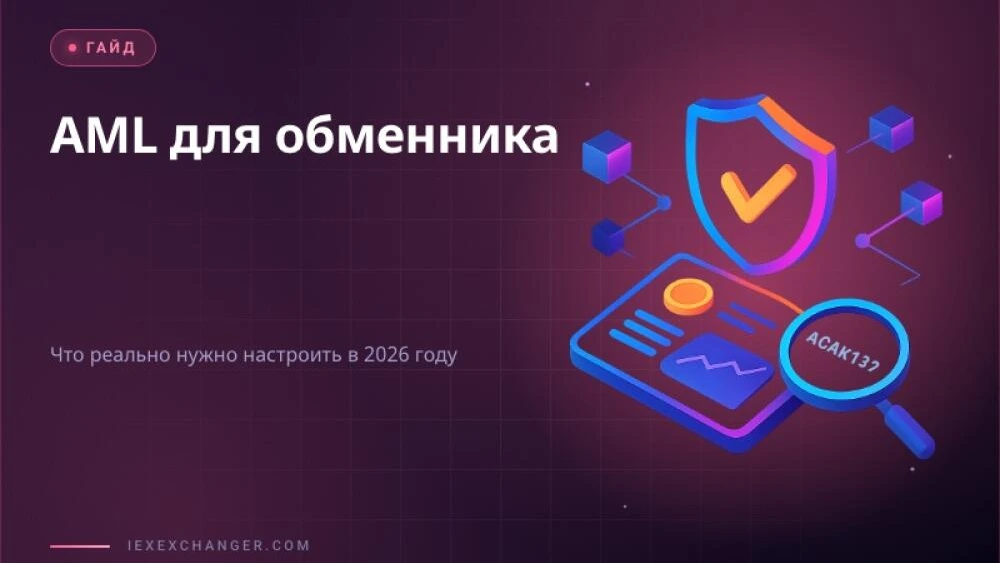
AML compliance for a crypto exchanger stopped being optional long ago — by 2026, it's a basic condition for staying in business. Without a working anti-money-laundering system, regulators and payment partners simply cut you off. Here's what you actually need to build, and where most small exchangers get it wrong.
What AML Is — and Why Your Exchanger Can't Ignore It
AML (Anti-Money Laundering) isn't a policy PDF gathering dust on your website. It's a living set of procedures: client verification, transaction monitoring, suspicious-activity reporting, and keeping proper records. For an exchanger, that means concrete actions on every trade — especially once amounts get significant or patterns start looking odd.
The key point even if you operate in a loosely regulated jurisdiction: you still have a bank, a payment processor, or a crypto custodian — and they all have their own compliance requirements. If you can't show that basic checks are in place, they'll drop you. Not the regulator — your own partners.
KYC: Who to Verify and How
KYC (Know Your Customer) means confirming who your client actually is. The threshold that triggers mandatory verification varies: in the EU under MiCA it starts at €1,000; in most other markets it's somewhere between $1,000 and $3,000 per transaction.
What this looks like in practice:
- Collect a government-issued ID (passport or national ID card) and store a copy securely.
- Run the client against sanctions lists — OFAC (US), UN, EU, and the relevant national authority. Easily automated via API services like Elliptic or Chainalysis.
- For high-value or repeat clients, verify the source of funds.
One reality check: "no-KYC exchanger" worked as a pitch in 2019. Today it either means KYC is just hidden — or it's an open invitation to fraudsters and regulators alike.
Transaction Monitoring: Red Flags You Can't Ignore
Monitoring means reviewing each trade for suspicious patterns. In practice, there are specific signals that should trigger a manual review every time.
- Structuring: a client makes five $900 trades instead of one $4,500 swap — the classic trick to stay under the KYC threshold.
- Convoluted fund routing: crypto arrived through ten different addresses in 20 minutes, all freshly created wallets.
- Profile mismatch: the client said they were exchanging personal savings, but they've moved $200,000 through you in a single month.
- Blacklisted addresses: the wallet has already been flagged by Chainalysis as connected to darknet activity or a sanctioned entity.
Any single red flag sends the transaction to manual review. If the grounds are solid, that's when you file a Suspicious Activity Report (SAR) — or its local equivalent.
Three Mistakes Almost Every Small Exchanger Makes
First: a policy exists, but procedures don't. A nicely worded PDF buried in a footer protects nobody — not from fraudsters, not from auditors. You need operational checklists that staff actually run through on every trade.
Second: checking inbound crypto, ignoring fiat. A suspicious bank transfer is just as dangerous as a suspicious wallet. The control has to be symmetrical.
Third: not keeping logs. When a regulator asks "show us all March trades," the answer needs to take minutes, not days. A proper log — date, amount, client, decision — is the insurance policy that has saved more than a few exchangers from being shut down.
Conclusion
AML compliance isn't bureaucracy or a luxury for big players. It's the practical layer that protects you from losing banking partners, getting accounts frozen, and facing scrutiny from financial watchdogs. Start small: sanctions screening, a KYC threshold, a basic ops log. Then build toward transaction monitoring and automation.
If you're launching or upgrading an exchanger, choosing a ready-made platform with compliance tools built into the engine from day one saves months of painful integration work — which is exactly what iEXExchanger provides.