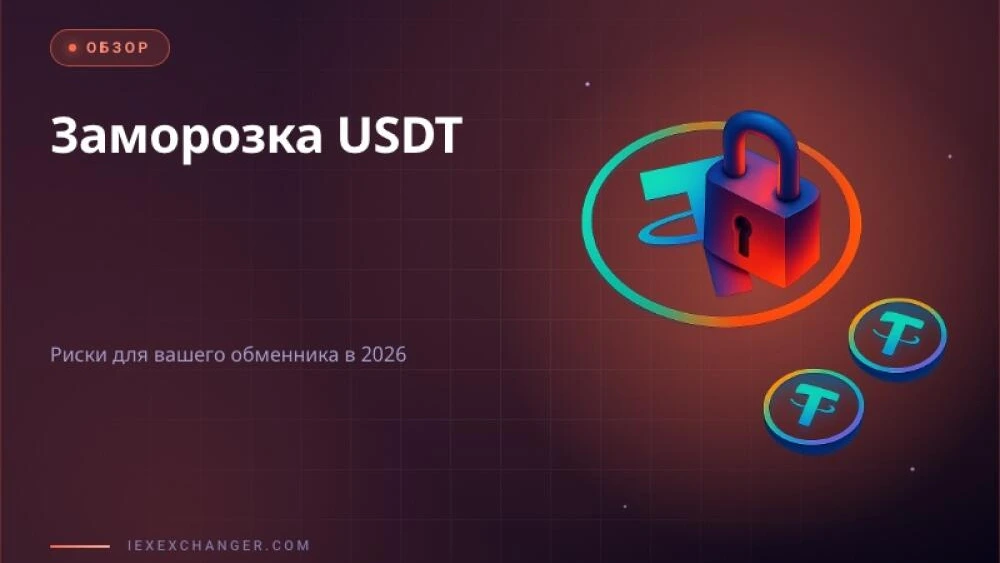
USDT freeze risk is real — not a hypothetical. Tether has blacklisted over 1,300 wallets worldwide, and most owners only found out when a transfer stopped going through. For a crypto exchange, losing access to liquidity means downtime and a hit to your reputation. Let's look at how the freeze mechanism actually works — and what genuinely helps you avoid it.
How Tether Freezes Addresses
The USDT smart contract has a built-in blacklist function — one call from the company and a specific address can no longer send tokens. The coins don't disappear: they still show up in your wallet, you can see them, but you can't move them anywhere. That's exactly why many people initially assume it's a network issue — and waste critical time.
The triggers vary. Most often it's a law enforcement request or a court order. Sometimes it's an internal Tether decision when fraud is suspected. The company typically doesn't notify the wallet owner — neither before nor after the block.
The USDC Case: $12.6M Frozen — Including Innocent Bystanders
In May 2026, Circle froze $12.6M in USDC sitting in a Zama protocol smart contract following a US court order. Among those affected were users with no connection to the transactions under investigation — their funds simply happened to be in the same contract.
This changes the picture. The risk isn't limited to USDT — any centralized stablecoin with a blacklist function is vulnerable. USDC works on the same principles. DAI is decentralized and has no single kill switch, but roughly 40% of its collateral has historically been USDC, creating an indirect exposure.
Who Gets Frozen in Practice
Three main scenarios play out:
- Regulatory or court order — the most common case. The issuer is legally required to comply; refusal risks losing their operating license.
- Contact with tainted funds — if your exchange received a transfer from a wallet on the OFAC sanctions list, your receiving address can end up under scrutiny.
- Smart contract freeze — like the Zama case: all funds inside the contract get frozen, including those of completely uninvolved parties.
Exchanges are most often caught by the second scenario. Incoming fund flows are diverse — manually checking every source address simply isn't realistic at scale.
How to Reduce Risk Without Losing Sleep
You can't fully insure against this, but here's what actually helps:
- Diversify your liquidity. Don't keep all reserves in one stablecoin. A working balance across USDT, USDC, and possibly DAI isn't paranoia — it's basic operational hygiene.
- Add AML screening on incoming funds. Even basic checks against OFAC SDN lists significantly reduce the risk of secondary sanctions exposure.
- Don't hold large amounts on hot wallets longer than needed. The faster liquidity moves through your system, the smaller the risk window.
- Monitor major enforcement cases. Freezes rarely come out of nowhere — they're usually preceded by public court proceedings. Staying informed buys you time to act.
Conclusion
A USDT or USDC freeze isn't a disaster for a well-run exchange — but it's a serious disruption for anyone who hasn't thought it through in advance. The mechanism exists, it gets used regularly, and that won't change. It's simply part of how centralized stablecoins work.
If you're building or scaling your own crypto exchange, iEXExchanger provides ready-made infrastructure with multi-stablecoin support — so you can build proper diversification in from day one, without reinventing every piece.