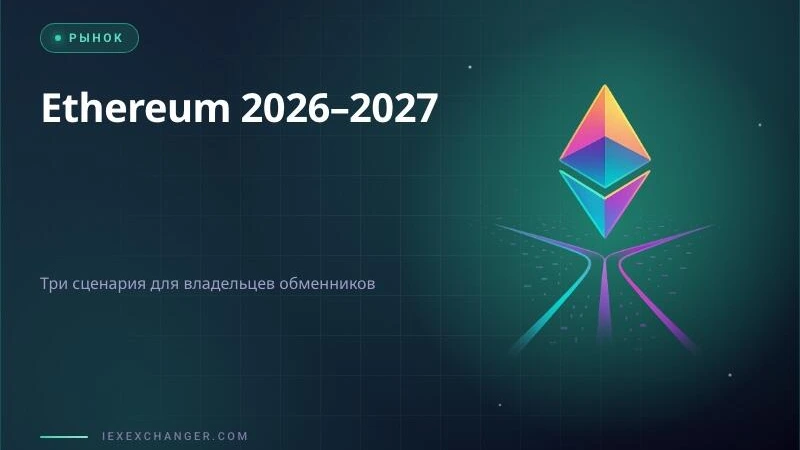
An Ethereum forecast for 2026 isn't a question you can answer with a single number. ETH is both an asset and infrastructure at once: the Ethereum network handles the bulk of USDC, DAI, and thousands of ERC-20 tokens in circulation, and gas costs directly affect your exchanger's margins. Instead of a price target — three honest scenarios and what each one means for your business.
Why Ethereum Matters to Your Exchanger More Than You Think
Most exchanger operators see ETH as just another line in their catalogue. In practice, Ethereum is the pipeline. The vast majority of USDC and DAI volume flows through it, most popular DeFi tokens are ERC-20, and even when a client walks in to swap USDT, Ethereum mainnet fees affect how competitive your pricing looks against TRON or Solana.
The larger your operation, the harder network congestion hits. Back in 2021–2022, Ethereum mainnet gas regularly reached $50–100 per transaction at peak times. Since the EIP-4844 upgrade (March 2024) and Pectra (May 2025), the picture improved significantly: L2 networks like Arbitrum or Base are now cheaper than mainnet by an order of magnitude. But the load comes back in periods of high market activity — and any exchanger operator needs to understand this dynamic to avoid being caught off guard.
What Has Already Changed: Pectra and the Institutional Factor
By mid-2026, Ethereum operates in a new reality for two key reasons. The first is the Pectra upgrade (May 2025): expanded L2 throughput via blobs, account abstraction through EIP-7702, and a raised validator balance cap. Together, these lower the entry barrier for institutional custodians and make the network noticeably more scalable. In plain terms: EIP-7702 lets a standard address temporarily behave like a smart contract, which opens the door to cleaner corporate wallet setups without extra steps.
The second reason is the spot ETH ETFs that have been trading in the US since July 2024. A spot ETF is, essentially, an exchange-traded fund that physically holds Ethereum and trades on traditional platforms like NYSE. Money from pension funds and brokerage accounts now flows into ETH without going through crypto exchanges. A portion of that liquidity is effectively locked inside ETF products and exerts less pressure on order books — a structural change that reshaped the market compared to 2023.
Three Scenarios: Where ETH Could Move in 2026–2027
There is no definitive answer. But we can map out three realistic scenarios and think through how to prepare for each one in advance.
Scenario 1: Regulatory Tailwind
The US and EU introduce clear rules for ETH staking inside ETFs and allow brokers to hold crypto on their own balance sheets. The result: a sharp rise in institutional demand. In this scenario, Ethereum becomes the settlement layer for tokenized assets — stocks, bonds, real estate — and stablecoins. For an exchanger: strong organic client flow, deep liquidity in ETH pairs, and a likely rise in average transaction size.
Scenario 2: Sideways with Hot L2s
The baseline — and most likely — scenario. ETH stays in a wide range, growth capped by competition from Solana, BNB Chain, and new L1 networks. But volumes on L2s — Arbitrum, Base, zkSync — keep climbing. For an exchanger, this is a workable steady state: fees are low, ERC-20 client flow is solid, but there is no big price move driving clients through the door by itself. Revenue comes from operational efficiency, not volatility.
Scenario 3: Sustained Pressure
Regulators block staking inside ETFs, major platforms face sanctions, and the broader market slides into a bear phase. Part of the institutional bid disappears. For an exchanger: commission revenue on ETH pairs shrinks, and clients migrate toward more stable pairs — USDT, BTC. Not a disaster, but something worth preparing for ahead of time: a diversified asset pool and no overconcentration in ETH reserves.
What This Means in Practice for Your Exchanger
Three different scenarios — but the practical takeaways for an operator largely overlap. Do not hold your entire reserve on ETH mainnet: split between mainnet and L2 networks to manage gas risk and speed up settlements. Watch the spread on ETH pairs closely — during high volatility it widens faster than on BTC or USDT, and if you have not built that into your margins, you can end up in the red right at the peak.
If your exchanger handles a lot of ERC-20 tokens, set up gas monitoring. Tools like ETH Gas Tracker let you shift heavy transactions to low-activity windows and cut fees by 40–60%. This is not a one-off trick — it is routine optimization that pays off every single week, regardless of which scenario plays out.
What to Watch: Indicators That Actually Matter
ETH/USD is the least informative metric if you track it without context. Far more useful:
- ETH staking rate — the share of coins in staking. The higher it goes, the less ETH is in free circulation and the sharper the price reacts to new demand or panic selling.
- L2 TVL — total value locked across L2 networks (the total amount of funds held in L2 protocols). If it keeps growing, the Ethereum ecosystem is alive and expanding even if the mainnet price is flat.
- USDC and DAI on-chain volumes — a proxy for business activity on the network. Businesses settle in stablecoins, and rising on-chain stablecoin volume signals that Ethereum is being used as real settlement infrastructure.
- ETF flows — weekly inflow and outflow data for spot ETH ETFs. Sustained inflows over several weeks signal institutional appetite. Sustained outflows are a reason for caution when replenishing ETH inventory.
Conclusion
Nobody has an accurate ETH forecast for 2026–2027 — that is simply the reality. But understanding which of the three scenarios the market is moving toward, and adapting your reserve strategy and operational processes in advance, is entirely within reach. Ethereum remains the primary settlement network for stablecoins and tokenized assets, and no serious exchanger can afford to ignore its trajectory.
If you are building or scaling your own exchanger and want it to run cleanly through any ETH scenario, take a look at the ready-made technical solutions from iEXExchanger — a platform built specifically for exchanger owners, not for end users.