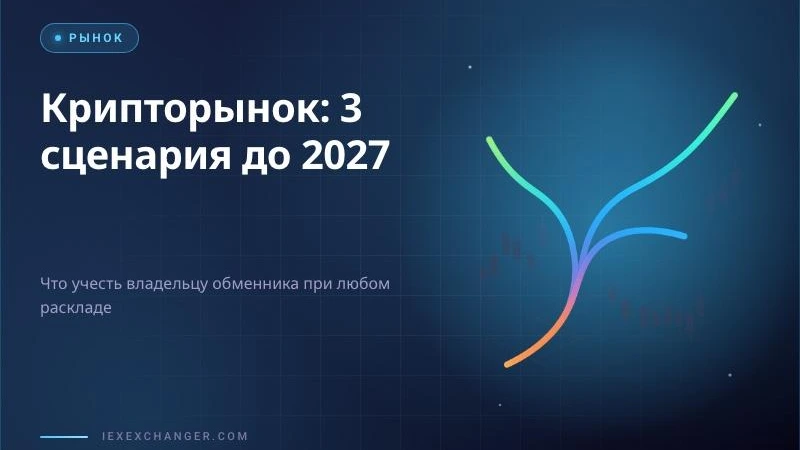
Crypto market forecast for late 2026 isn't a single number — it's three plausible scenarios, each with its own triggers and risks. Regulators are loosening the rules for wallets, banks are moving into custody, and stablecoins are fighting regulators over yield. Here's what's actually happening, where the market could swing, and what exchanger owners should be watching right now.
What's Already Moving the Market
Three trends from the past few months are worth keeping in mind before you read any forecast. Regulators in several jurisdictions are easing requirements for crypto wallets and custodians — the industry is slowly stepping out of the grey zone. Traditional banks and exchanges are testing tokenized stocks and digital asset custody. And monetary policy at major central banks remains unsettled, something crypto markets still react to sharply.
On their own, each of these is just a headline. Together, they mean the rules of the game are shifting faster than most market participants can adapt. So the honest answer to "what happens next" isn't one number — it's a handful of scenarios with different odds.
Scenario 1: Gradual Legalization and Institutional Inflows
If regulators keep loosening the rules and banks keep expanding custody services, the market finally gets what it's been missing: predictability. Institutional money moves in slowly, but it tends to stay, and volatility gradually eases in this scenario.
For an exchanger, that's mostly good news — a growing pool of customers wants an easy way into crypto without the corporate onboarding hassle of the big platforms. But competition grows too — you're no longer just competing with the exchanger down the street, but with a banking app.
Scenario 2: Regulatory Turbulence
The flip side: some jurisdictions tighten the screws faster than others can agree on common rules. The market gets shaky — not because of fundamentals, but because uncertainty is something markets dislike even more than bad news.
In this scenario, spreads and volatility widen, and so does the risk for anyone sitting on an oversized position in a single coin. There's no silver bullet, but diversified reserves and a genuinely careful approach to compliance beat betting that "it'll blow over."
Scenario 3: The Market Splits by Jurisdiction
The third option isn't a boom or a bust — it's fragmentation. Rules in the US, Europe and Asia keep diverging, and what's allowed in one country becomes questionable in another. The market doesn't collapse, but it stops being one market — networks, fees and available tools start looking different region by region.
For an exchanger, that means one thing: you can't build a business around a single jurisdiction and a single rulebook. Flexibility in networks, currencies and payment methods stops being a nice-to-have and becomes a survival trait.
What Exchanger Owners Should Watch
A forecast is only as useful as the actions you can take with it. Three things are worth tracking regardless of which scenario wins out:
- How fast regulatory requirements shift in your key jurisdictions — this hits compliance and licensing faster than any price move.
- How diversified your reserves and payout rails actually are — a single liquidity channel turns into a bottleneck the moment things get tense.
- How volumes and spreads behave during news-driven turbulence — an early sign the market is more nervous than the price lets on.
Common Mistakes When Preparing for Any Scenario
The most common mistake is preparing for only one scenario — usually the optimistic one. The second is keeping all your liquidity and integrations tied to a single market or network. The third is reacting to regulatory news after the fact instead of building in a buffer beforehand.
None of these scenarios plays out in a pure form — reality usually borrows a bit from each. The resilient operator isn't the one who guessed right, but the one who never depended on a single outcome in the first place.
Conclusion
Whichever scenario plays out, exchanger owners need infrastructure that doesn't break when the rules change and can absorb volatility spikes without constant manual firefighting. You can launch or upgrade that kind of business on a ready-made platform with iEXExchanger — from the exchanger engine to automated rate updates.