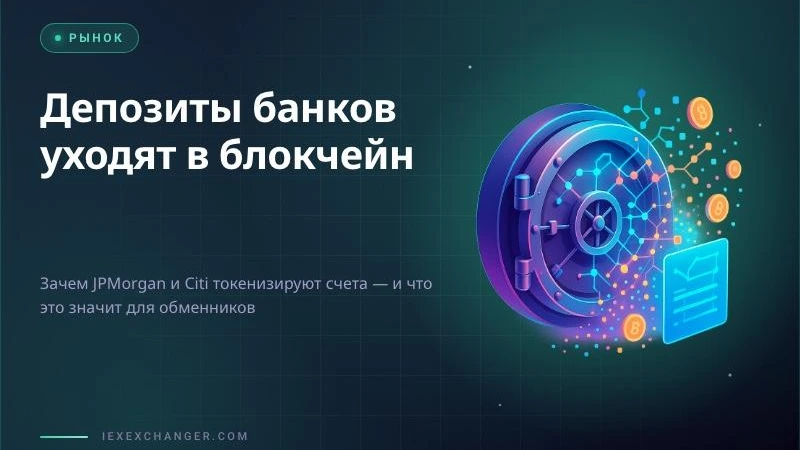
Tokenized bank deposits turn an ordinary bank balance into a blockchain token that settles in seconds instead of waiting for banking hours. JPMorgan already pushes hundreds of billions of dollars a year through its Kinexys platform this way, and if your settlement bank joins the club, the ripple eventually reaches exchanger operators too.
What a tokenized deposit actually is
Strip away the jargon and it's simple: a tokenized deposit is your bank's promise to pay, wrapped in a token. The bank effectively hands you a digital receipt — "we're holding your dollar, here's its on-chain twin, move it around inside our network." It isn't a new currency and it isn't a public coin. It's the same old bank account with a programmable front end.
JPMorgan runs this through Kinexys (formerly Onyx), where tokenized deposits already settle intraday payments between corporate clients and even repo trades that used to wait for the close of business. Citi runs a similar closed loop called Token Services for its own client base.
How it differs from a stablecoin — and the difference is the whole point
A stablecoin is a token on a public blockchain that anyone can send from any wallet to any wallet, anywhere — and the issuer (Tether, Circle), not the bank you bought it from, is on the hook to redeem it. A tokenized deposit plays by different rules:
- One specific issuing bank owes you the money — not a third party
- The token lives inside that bank's network or a closed bank consortium, not a public chain
- Sending it straight to a client at another bank usually still needs the same old interbank rails
- Access is reserved for vetted corporate clients, not the general public
Simplest way to picture it: a stablecoin is cash you can hand to anyone. A tokenized deposit is a bank ledger entry — just a faster, more programmable one than a regular wire.
Why banks are chasing this
The incentive for banks is obvious — internal settlement speeds up and treasury gets liquidity around the clock instead of being tied to Fedwire or SWIFT cut-off times. A multinational moves cash to a subsidiary on a Saturday night across time zones and it arrives instantly, not Monday morning. Less operational risk, less idle cash — an easy sell inside a bank.
What this actually changes for an exchanger
Right now — almost nothing, and it's worth saying that plainly. Access to tokenized deposits today goes to large corporate clients with the volume and reputation an average small or mid-size exchanger doesn't have yet. A frozen account or a slow compliance review on an incoming payment won't disappear just because your bank rolled out a token.
Still, the trend is worth watching. If your settlement bank sits inside one of these consortiums, it could eventually mean faster internal transfers between your corporate counterparties — no weekends, no payment queue. Think of it as an extra settlement lane, not a replacement for what you already use.
The catches nobody's solved yet
The big one: tokens from different banks don't talk to each other. JPMorgan's token can't reach Citi's token without the same interbank bridge used today, so cross-bank and cross-border transfers stay exactly as slow as before. Regulatory treatment varies by country too — in some places it's just a deposit with a digital wrapper, in others regulators are still writing the rulebook.
And the part that matters most for exchanger owners: if your business already sits under extra compliance scrutiny, tokenizing the deposit changes nothing about that. Same bank, same review, same risk policy. Don't expect this to fix a difficult banking relationship.
Conclusion
Tokenized bank deposits are a parallel rail banks are building for themselves, not a challenger to stablecoins in an exchanger's day-to-day flow. For cross-border payments and client settlement, USDT and its peers remain the practical tool for years to come. What actually solves an exchanger's real bottleneck is owning the payment and client infrastructure instead of depending entirely on a bank's goodwill — something you can build and automate on a ready platform like iEXExchanger.