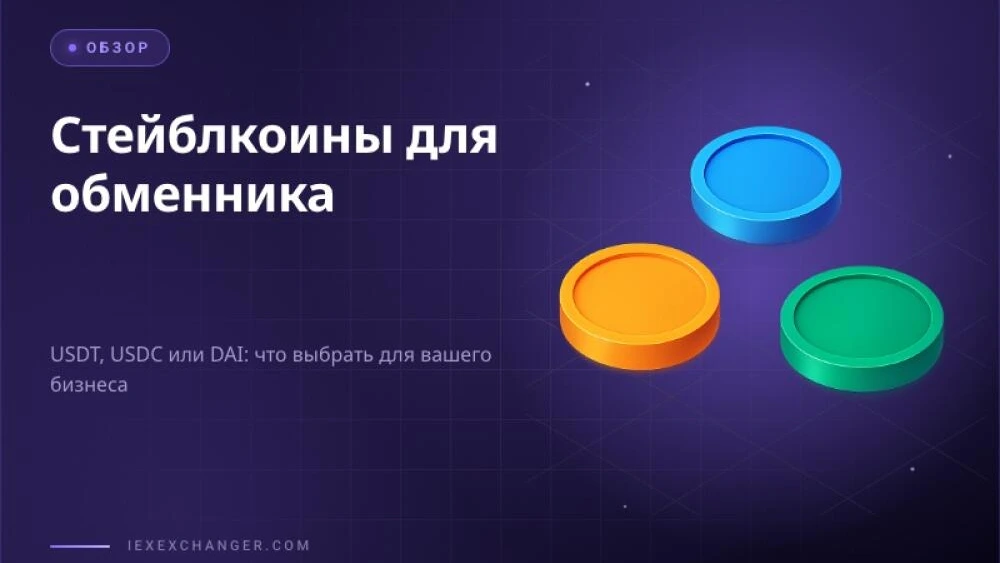
Stablecoins for your crypto exchanger aren't interchangeable — despite what the price tag suggests. USDT, USDC and DAI all sit near one dollar, but they're built on fundamentally different foundations. Choose the wrong one and you could end up with frozen funds, a compliance trail that banks won't touch, or razor-thin liquidity exactly when you need depth. Here's what actually matters.
Same price, very different products
On the surface: all three trade around a dollar, appear on major exchanges, and are accepted across most trading platforms. Below the surface, they work completely differently.
Tether issues USDT and claims every token is backed by real assets in reserve. There's no full public audit — but USDT trades everywhere, from Binance to local p2p markets. Spreads are tight. Liquidity is deep. By trading volume it's the most popular stablecoin in the world, and it's not even close.
Circle, alongside Coinbase, issues USDC: monthly independent audits, strict US regulatory compliance, transparent reporting. Fewer trading pairs, but a clean paper trail.
DAI is a decentralized stablecoin from the MakerDAO protocol. No company issues it — DAI is minted through collateralized positions in smart contracts. Nobody can freeze an address individually. But liquidity is noticeably thinner.
USDT: maximum liquidity — and one uncomfortable detail
By trading volume, USDT is the undisputed market leader. If your exchanger needs deep pairs with minimal spread — the smallest possible gap between buy and sell price — it's the obvious choice.
But there's a detail people rarely say out loud: Tether can — and does — freeze addresses. Its blocked-address registry runs into the hundreds, mostly at law enforcement request. If your hot wallet address lands on that list, your funds are locked with no appeals process.
For a legitimate exchanger with clean turnover, that's an abstract risk. But it's a real one worth knowing about when you structure your reserves.
USDC: compliance-friendly — with one famous exception
USDC is the right choice where a clean transaction history matters — for banking partners, regulators, and fintech integrations. Circle publishes monthly audits and provides documentation you can hand to any compliance officer. Many fintech partners won't touch USDT on principle; in those cases USDC becomes the only workable option.
But USDC had its own stress test. In March 2023, Circle disclosed it held roughly $3.3 billion of USDC reserves at Silicon Valley Bank — right before it failed. USDC briefly fell to $0.87. It recovered fast once the US government guaranteed deposits, but those few hours served as a reminder: "regulated" doesn't mean "risk-free."
DAI: when independence matters most
DAI is a stablecoin with no freeze button. It's issued by smart contracts, not a corporate treasury: users lock crypto collateral and receive DAI in return. If it's critical to you that no company office can lock your funds — DAI solves that problem cleanly.
The trade-off: liquidity is noticeably thinner than USDT. Deep DAI/BTC or DAI/ETH pairs on major exchanges are rare, and spreads can widen during market stress. The collateral mechanics also take real time to understand — it's not a "top up and go" setup.
Three questions to help you decide
There's no stablecoin that fits every exchanger, every time. The right choice depends on three parameters specific to your business:
- Where is your audience's liquidity concentrated? If most volume flows through major centralized exchanges, USDT wins by a wide margin. If you work with European fiat partners, take a closer look at USDC.
- How transparent do your banking partners need you to be? By 2026, many fintechs and banks have internal restrictions on USDT. It's no longer unusual — it's a trend.
- Are you comfortable with address-freeze risk? If not, you'll want DAI or a split: keep part of your reserves in USDC as a fallback.
Many exchangers run two stablecoins at once: USDT for core operations, USDC or DAI as a hedge against problems with the first. It's a sensible approach.
Conclusion
Stablecoins for your crypto exchanger are an operational decision — one that shapes your liquidity, your risk profile, and your relationship with banks. USDT wins on reach. USDC wins on transparency. DAI wins on independence. There's no single right answer, but there is a right question: what matters most for your specific business right now?
If you're building an exchanger from scratch or strengthening an existing one, iEXExchanger provides a ready-made engine, rate automation tools, and wallet integrations — so you can focus on running the business, not the infrastructure.