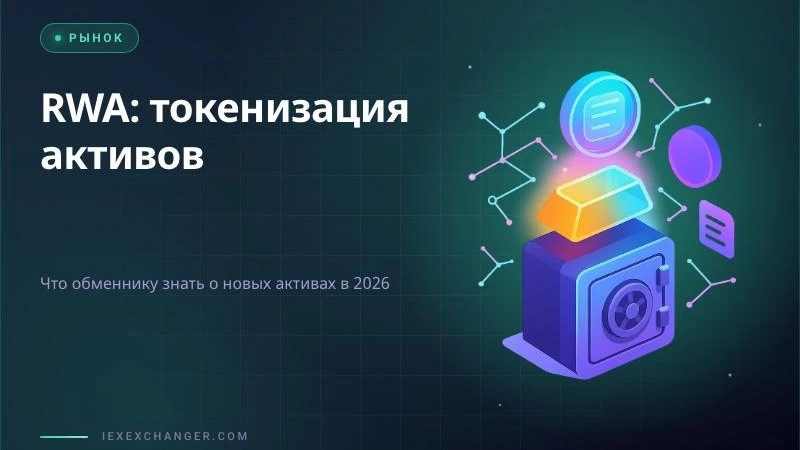
Real-world asset tokenization — RWA for short — turns gold, bonds, real estate or a fund share into a blockchain token. It's not a buzzword anymore: major financial institutions are already issuing these tokens, not just talking about them at conferences.
One clear signal: tokenized government-bond funds run by major asset managers have been live for years and have already handled real money at scale. On top of that, regulators like the UK's FCA are drafting dedicated rules for tokenized gold — a sure sign the topic has moved past the niche stage.
What RWA actually means
Picture a gold bar sitting in a vault. Instead of a paper certificate, you get a blockchain token that proves your share and can change hands in minutes instead of a week of paperwork. That's RWA in one sentence: a digital wrapper around a physical or financial asset.
The difference from a typical crypto token is the anchor: an RWA token is backed by something real that someone else custodies and has to account for. That makes it behave more like a bond or a share than like bitcoin.
What's already happening
Institutional tokenized treasury funds already manage serious sums — this isn't a pilot, it's a working product. At the same time, major payment and financial firms, not scrappy startups, are the ones building settlement blockchains for institutional finance.
Regulators are catching up too: dedicated regimes for tokenized gold, reserve requirements for stablecoin issuers, closer scrutiny of who actually custodies the underlying asset. The market is maturing faster than the rulebooks, and that gap creates friction.
Three scenarios for the next few years
If institutional demand keeps climbing and regulators converge on shared custody and disclosure rules, RWA tokens become a standard line item next to stablecoins. That's the optimistic path — not a guarantee.
- Acceleration: banks and funds move bonds and real-estate funds on-chain at scale, and retail demand follows.
- Friction: different countries adopt incompatible custody rules, and RWA stays an institutional product rather than a mass-market one.
- Niche settlement: RWA sticks to a few asset types — gold and government bonds — without spreading to real estate or other legally complex assets.
Which path wins depends less on technology and more on how fast regulators across jurisdictions agree with each other. Right now, that's happening slowly.
What it means for exchanger owners
If your clients already hold stablecoins and expect more from your platform, a question about tokenized gold or bonds is a matter of when, not if. Three things are worth planning for now.
- Liquidity: not every RWA token has a deep market for fast settlement, especially niche issues — know in advance who you'd route those trades through.
- Compliance: the issuer needs a clear, checkable process for proving the reserve — working with an opaque issuance is a reputational risk.
- Wallet support: RWA tokens are often issued on the same networks as familiar stablecoins, so the technical integration is usually simpler than it sounds.
Common mistakes
The most common one: adding a new asset because it's trending, without checking who actually verifies the reserve behind it. The second: treating RWA as a stablecoin replacement, when in practice they're different tools with different liquidity and settlement speed.
Conclusion
RWA isn't the next bitcoin — it's a slow, persistent integration of traditional assets into blockchain infrastructure. For an exchanger, the smart move isn't chasing every new token, but tracking which issuances survive scrutiny from both time and regulators. If you're building or upgrading your own exchanger to handle new asset types, iEXExchanger is a platform worth a look.