USDT vs USDC for your crypto exchanger — a choice that directly affects liquidity, settlement speed and regulatory risk. Both stablecoins are pegged to the dollar, but they work differently under the hood: reserve structures, transparency, compliance status and supported networks all diverge. Here is what to weigh before you decide.
How USDT and USDC Differ at Their Core
USDT (Tether) was launched by Tether Limited in 2014 and remains the oldest major stablecoin. USDC was launched in 2018 by the Circle and Coinbase consortium. Both claim 1:1 dollar backing, but their reserve structures are different.
Tether has long been criticised for opacity: historically, part of its reserves included commercial paper rather than pure cash. Circle, by contrast, publishes monthly attestations from independent auditors and holds reserves primarily in short-term US Treasuries. This does not make USDT bad — they simply have different transparency profiles.
Liquidity: Where USDT Is Untouchable
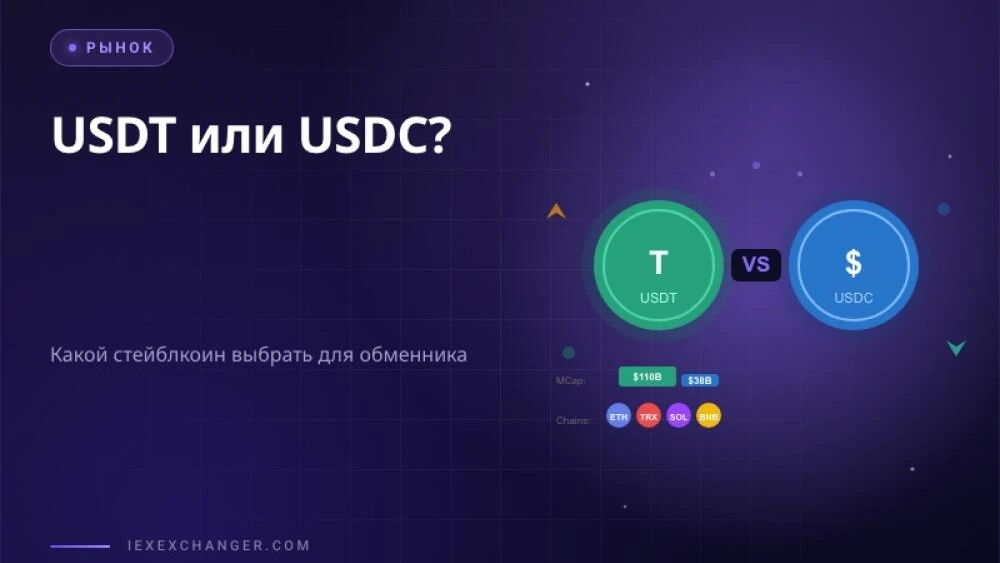
By trading volume, USDT is the undisputed leader. Its market cap exceeds $110 billion, and USDT trading pairs exist on every major exchange. For an exchanger handling dozens of directions, that matters: deep liquidity narrows conversion spreads and speeds up order execution.
USDC is considerably smaller (~$35–40 billion), but still ranks in the top five by market cap. Its share grew after the FTX collapse, as part of the market shifted to a more transparent asset. On major exchanges the gap is noticeable; at the level of an average exchanger, it is negligible.
Regulatory Status and Compliance
USDC was built with regulated markets in mind. Circle holds licences in several jurisdictions, actively engages with regulators, and was among the first to adapt to Europe's MiCA framework. If your exchanger serves European clients or you are pursuing a licence, that is a meaningful argument for USDC.
USDT is less convenient for formal compliance, but its scale makes it a de facto standard. Across most CIS countries, Asia and the Middle East, USDT dominates — ignoring it simply is not an option.
Networks, Fees and Speed
Both stablecoins run on Ethereum (ERC-20), Tron (TRC-20), Solana, BNB Chain, Polygon and several other networks. TRC-20 is the cheapest option — often $0–0.5 per transaction with confirmation in 3–5 minutes. Solana is also fast and inexpensive, but with slightly lower liquidity depth.
For an exchanger, the network determines not just the fee but also how quickly client funds arrive. Most experienced operators default to TRC-20 for both coins.
Practical Breakdown: When to Use Which
- Maximum liquidity and reach: USDT — more exchanges, more trading pairs, a broader client base.
- Compliance and licensing: USDC — more predictable under regulatory scrutiny.
- Operating under MiCA in Europe: USDC is preferred — Circle already meets the requirements.
- CIS, Asia and MENA markets: USDT is the dominant standard; dropping it makes no sense.
In practice, most exchangers support both. Clients come with what is convenient for them — and that is the right approach.
Conclusion
USDT and USDC are not competitors in the sense that one replaces the other — they are tools with different strengths. If your exchanger is just launching, start with USDT as the core direction and add USDC for European users. Already operating? Check whether there are gaps in your coverage. You can launch your own exchanger with support for current trading pairs on the iEXExchanger platform.