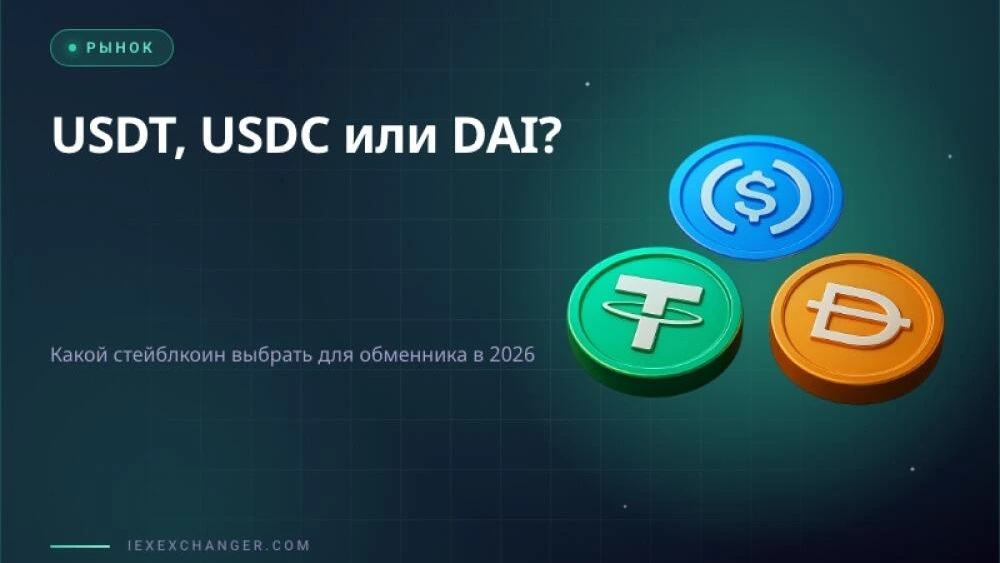
Choosing a stablecoin for your exchanger is not as simple as just use USDT. Behind each coin's stable price hides a different mechanism, regulatory exposure, and set of operational quirks. USDT, USDC, and DAI lead the market — and as an exchanger operator, knowing what sets them apart matters before you build your entire turnover on one of them.
Three Stablecoins, Three Risk Models
A stablecoin is a crypto asset pegged to the dollar (or another currency). But the peg mechanism differs significantly between them. Think of it as three types of deposits: one at a commercial bank, one in a regulated money-market fund, and one in an automated smart contract with no human owners. All three give you a dollar — but the level of trust, transparency, and control is very different.
- USDT (Tether) — centralised, backed by Tether Ltd. reserves.
- USDC (Circle) — centralised, regulated, with monthly independent audits.
- DAI (MakerDAO) — decentralised, collateralised by crypto through smart contracts.
USDT: The Most Liquid — With Caveats
USDT accounts for around 70% of the stablecoin market — which for an exchanger means maximum market depth and the tightest spreads across most trading pairs. A spread is the gap between the buy and sell price; the narrower it is, the better your exchanger works with available liquidity. If you operate dozens of exchange directions, you will find USDT everywhere: with partners, in P2P markets, on every major exchange, always.
The downside is that Tether's reserve transparency still draws scrutiny from regulators in the EU and other jurisdictions. The EU's MiCA framework, in full effect from 2024, has effectively restricted USDT for licensed operators in Europe. If you work with European banking partners or are considering a licence, that is worth factoring in. For CIS, Asian, and Latin American markets, USDT remains the de-facto standard.
USDC: Compliance-First, at a Liquidity Cost
USDC is issued by Circle in partnership with Coinbase. Reserves are held in US Treasuries and undergo monthly independent audits — making it the most compliance-friendly choice for businesses with US or European banking relationships.
There is a nuance exchanger operators sometimes overlook. In March 2023, Circle temporarily halted redemptions following the collapse of Silicon Valley Bank — USDC briefly lost its peg and fell to $0.87. Everything normalised within hours, but the episode made one thing clear: a centralised issuer with banking exposure is a real operational risk for an exchanger's working capital. USDC is excellent for serving corporate clients who require an audit trail, but keeping your entire liquidity in it is unwise.
DAI: Decentralisation for Those Who Manage Risk Carefully
DAI is created through MakerDAO: users lock crypto collateral (ETH, WBTC, USDC) in smart contracts and receive DAI. No central issuer, no bank account — theoretically, no regulator can press freeze.
In practice, that means complexity. DAI's peg is maintained not by reserves but by arbitrage mechanisms and protocol parameters — during sharp ETH volatility, the coin drifts around $1 more than USDT or USDC. Liquidity on many venues is lower, spreads are wider. For a high-volume, thin-margin exchanger, that is noticeable. DAI makes sense as a diversification element, but building your primary turnover on it only works if your users are already DeFi-native.
How to Choose: A Practical Framework
There is no one-size-fits-all answer. The right choice depends on your partners, markets, and regulatory status.
- Maximum turnover and global liquidity — USDT. The standard for most exchange directions.
- European partners or licence preparation — USDC or local alternatives (EURC, EURS).
- DeFi directions and decentralised segments — DAI as a supplementary tool.
- Reserve diversification — keep no more than 60–70% in any single stablecoin.
A practical baseline: primary turnover in USDT, 20–30% of reserves in USDC for compliance coverage, a small DAI allocation for DeFi pairs — if they are part of your lineup.
Conclusion
USDT remains the primary workhorse for most exchangers — liquidity wins. But putting everything in one coin is becoming increasingly risky: the regulatory landscape is shifting, and every stablecoin has a scenario where it fails. Diversifying across two or three assets reduces operational risk without meaningfully hurting efficiency. If you are launching or scaling your own exchanger, iEXExchanger supports multi-stablecoin operations and helps you automate rates and settlements.