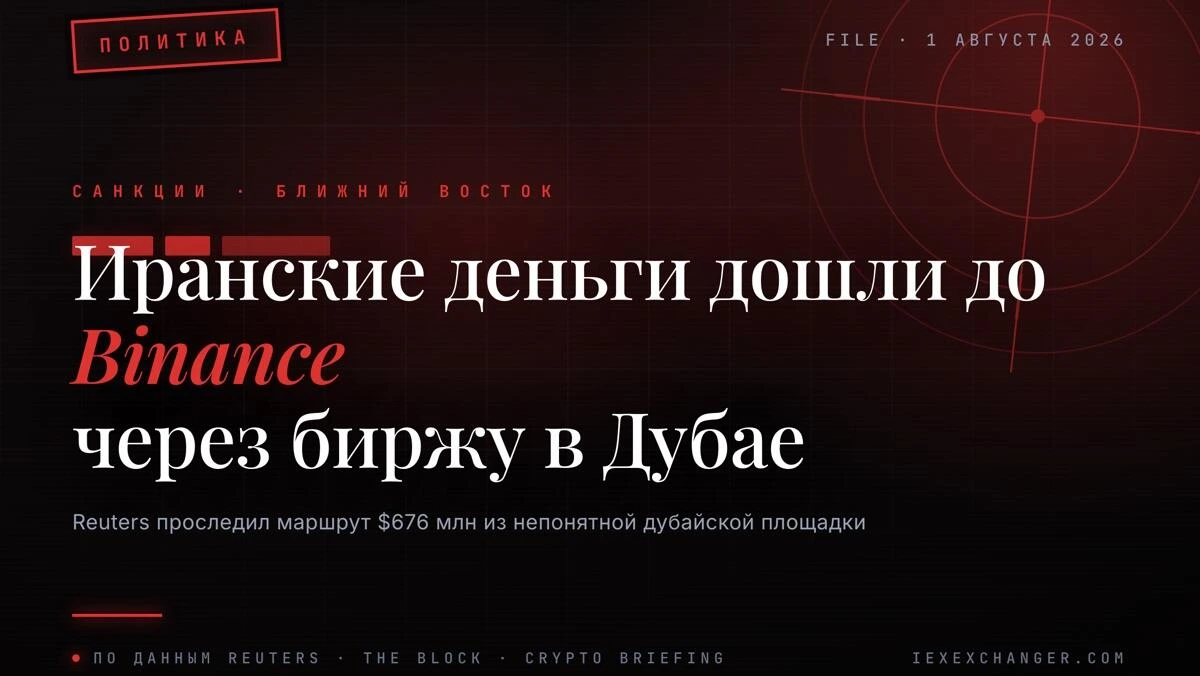
$676 million — that's how much Reuters traced flowing into Binance from an Iranian money pipeline that spent the past two years posing as an ordinary Dubai crypto exchange. Not a licensed one, though: Shelbit operated without authorization, and Dubai's regulator VARA only ordered it to shut down on July 24.
Shelbit is run by Iranian expatriate businessman Siavash Kayvanpour. Since May 2024, the platform processed more than $4 billion — and these weren't random transfers. Reporters found among Shelbit's clients a network of over 2,000 Farsi-language illegal gambling sites promoted by influencers Sasha Sobhani and Pooyan Mokhtari. Some wallets interacted directly with Iran's central bank, funneling roughly $125 million. Another $20 million came from a mining operation investigators link to Iran, with some addresses tied to the Islamic Revolutionary Guard Corps.
The timing is what stings most for Binance. Of the $676 million that reached the exchange, about $540 million arrived after VARA first fined Shelbit in January 2025 for operating without a license. The money kept flowing even after that first regulatory red flag.
Binance maintains that Shelbit never held a formal account on its platform and that its compliance program worked as intended: after an internal review in October 2025, linked accounts were frozen and reported to law enforcement. Still, the exchange doesn't deny accepting hundreds of millions of dollars over the years from users tied to Shelbit — it says independent analytics firms simply hadn't flagged those transactions as high-risk at the time.
The story lands against an already tense backdrop: the US Treasury confirmed it's aware of the investigation and takes it “very seriously,” while talks on a new nuclear deal with Tehran are stalling — prediction markets put the odds of an agreement by mid-August below 1%. This isn't Binance's first brush with sanctioned-adjacent traffic either; the Shelbit trail also turned up addresses linked to Nobitex, Iran's largest crypto exchange.
The real question now isn't whether Binance broke the letter of the law, but how much any large exchange's compliance is worth if an unlicensed middleman can push billions through it for two years straight.