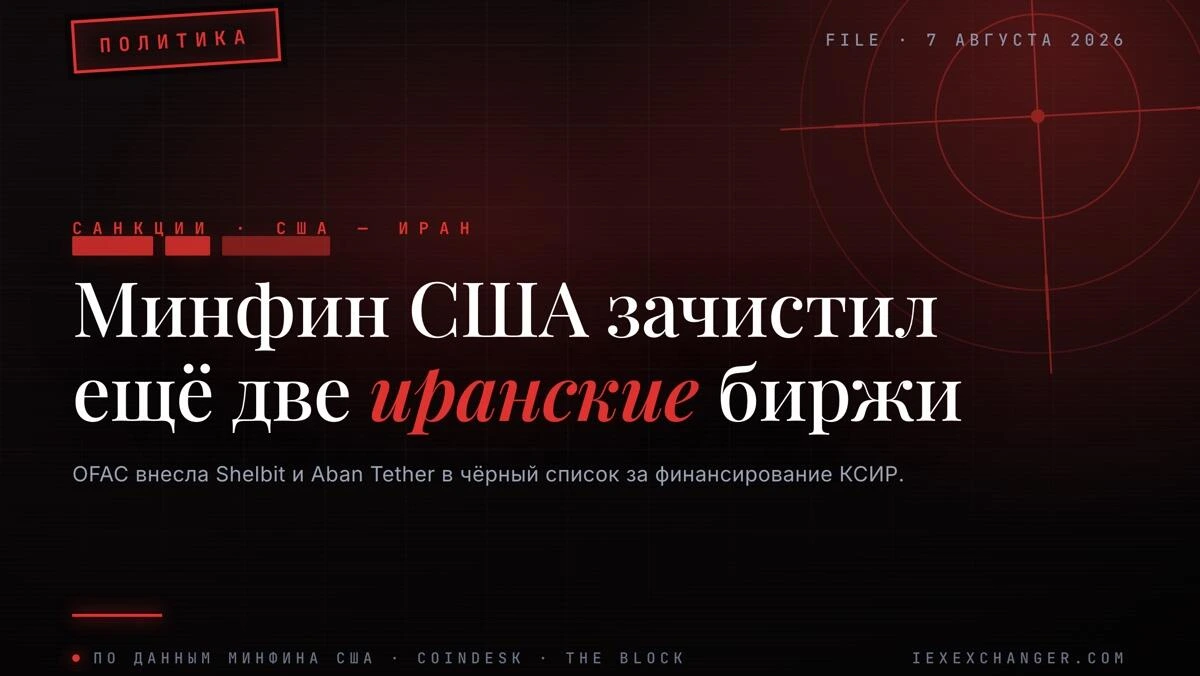
The US Treasury widened its sanctions net on Iran by two more crypto exchanges. On Friday, the Office of Foreign Assets Control blacklisted Shelbit and Aban Tether, accusing both of funneling money to Iran's Islamic Revolutionary Guard Corps and helping the regime dodge sanctions.
According to OFAC, wallets tied to the IRGC sent over $1 million to Shelbit addresses, while more than $2 million flowed back out to Guard-linked entities and other US-designated terrorist groups. The exchange's operator, Siavash Kayvanpour, was born in Iran and holds Dominican and Afghan citizenship; he ran the business through a Georgian entity called SHPS Shelbit while controlling related companies in Poland and the UAE. Treasury says wallets under his control also sent over $2 million to Nobitex, Iran's largest crypto exchange, which was sanctioned itself back in June.
Aban Tether, based inside Iran, allegedly processed millions of dollars in transactions tied to other sanctioned Iranian platforms including Nobitex, Wallex, Bitpin and Ramzinex. Alongside the two exchanges, OFAC hit individuals and a wider network of exchange houses and shell companies that Treasury says have moved Iranian oil-sale proceeds around the banking system for years.
"Whether in dollars, rials, or crypto, Treasury will hunt down and dismantle the illicit financial networks that keep the regime afloat," Treasury Secretary Scott Bessent said in a statement.
This is the fourth Iran-crypto sanctions action this year. In January, OFAC designated Zedcex and Zedxion — the first Iranian exchanges ever sanctioned specifically as crypto platforms. June brought Nobitex. In July, Treasury blacklisted wallets tied to Iran's central bank, prompting Tether to freeze $131 million in stablecoins. The pattern is straightforward: with traditional banking channels closed off, Tehran keeps routing money through crypto exchanges and intermediaries in third countries, and Washington keeps shutting each new route down.
For ordinary users of platforms like Shelbit, the designation means instant loss of access wherever an exchange complies with US sanctions rules. For the broader market, it's another sign that regulators are getting much better at tracing transaction chains that used to look anonymous.