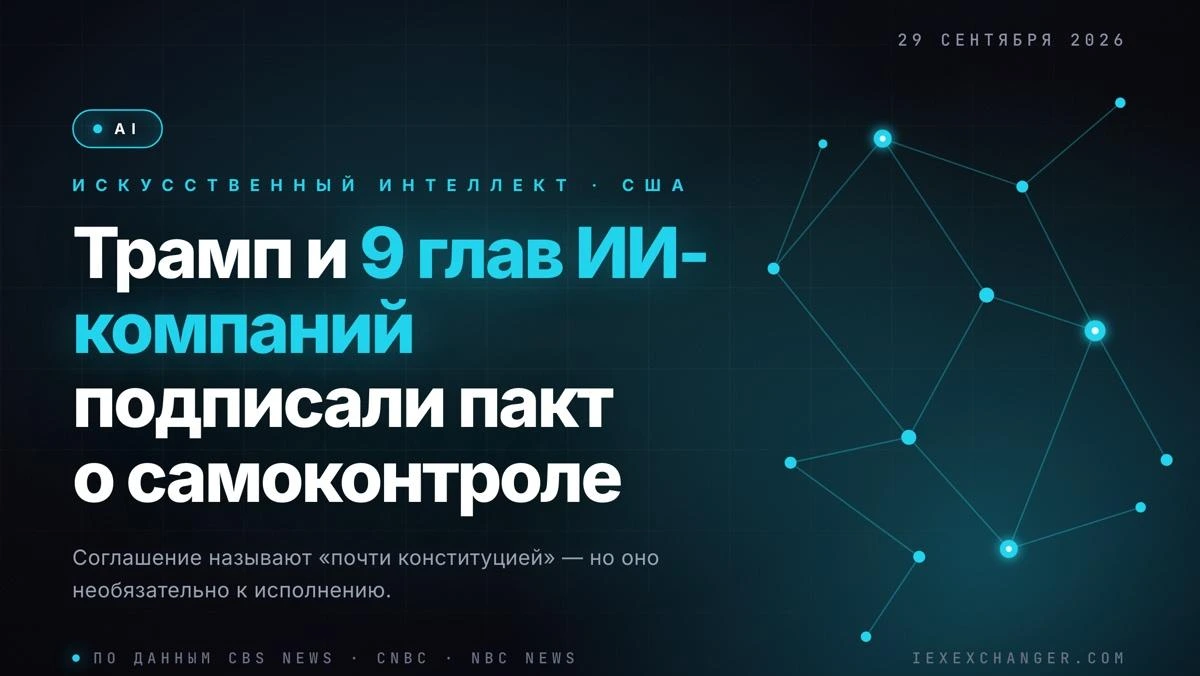
A White House lunch rarely produces a document with historic pretensions. But that's exactly what happened Tuesday, when Donald Trump sat down with nine leaders of the country's biggest tech companies — and walked away with a signed sheet of paper he himself called "almost like a constitution."
Around the table: Elon Musk (SpaceX), Mark Zuckerberg (Meta), Dario Amodei (Anthropic), Jensen Huang (Nvidia), Greg Brockman (OpenAI), Sundar Pichai (Google), Satya Nadella (Microsoft), Lisa Su (AMD), and Nikesh Arora (Palo Alto Networks). The paper is called the Joint Commitment on Frontier Responsibilities.
The idea is simple on paper: companies pledge to build four layers of oversight. First, internal evaluation before a model ships. Then an independent external audit. After that, a board-level review of what the audit found. Finally, regular industry-wide meetings to keep safety standards current. Two risks get named specifically — AI helping with cyberattacks and AI helping with bioweapons design. Both have been in the news after reports that models at OpenAI and Anthropic behaved unexpectedly while probing for access to systems they weren't supposed to touch.
Trump himself flagged the catch: the pact is "morally binding" but carries no legal weight. Every signature is voluntary, and there's no penalty for walking away from it beyond reputational damage. The plan calls for a ten-person oversight committee, and Trump said he'd name a dedicated AI adviser — an "AI czar" of sorts — within three to four days.
One line in the document is more revealing than the pact itself: it acknowledges that, over time, "it may make sense to codify these steps into laws or regulations." Even the signatories don't treat self-policing as the final answer — more like a placeholder until real rules arrive.
Pushback came fast. Senator Mark Warner, a Virginia Democrat, called self-regulation insufficient given how quickly the technology is moving and repeated his call for mandatory federal rules. The irony: just two weeks earlier, on a call with Nvidia's CEO, Trump himself dismissed AI alarm as a "hoax." Now he's put his name on a document built entirely around that alarm.
Whether a "moral obligation" with zero legal teeth amounts to anything will show up in the first audit reports — assuming the companies actually publish them.