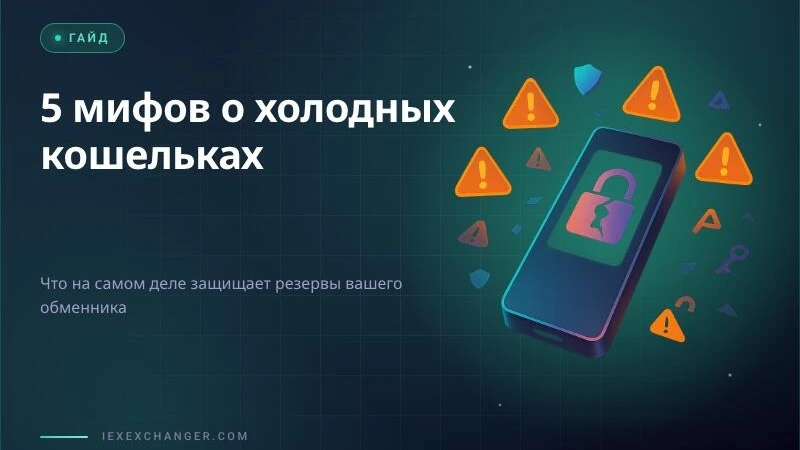
A cold wallet for your crypto exchanger is one of the most important tools for protecting reserves. Buy a Ledger, lock it in a safe — and you feel like the job is done. In practice, most exchanger operators believe a handful of dangerous myths about cold storage, and each one has a real price tag.
Why a cold wallet for your crypto exchanger is just one layer
A hardware wallet protects your private key from remote attack. That matters. But an exchanger has at least four other vulnerabilities the device does nothing about — and those cause more losses than direct network hacks do.
Myth 1: "A hardware wallet protects against everything"
Key protection and transaction protection are two completely different things. A Ledger won't let an attacker near your key over the internet. But if the operator signs a transfer to a phishing address themselves — the device faithfully executes the command. The money leaves. The device did exactly what it was told.
Then there's the physical scenario: if an attacker gets hold of the device and knows the PIN, the funds move without any network hacking at all. A hardware wallet protects the key. Not the transaction, not the operator's mistake, not a physical theft.
Myth 2: "One device is enough for backup"
Devices fail — batteries swell, controllers die, hardware gets lost in an office move. Without a seed phrase stored separately from the device, access to your reserves simply disappears. Permanently.
But keeping the seed in the same drawer as the device isn't a backup — it's an illusion. The minimum viable setup: two physically separate seed storage locations and at least one spare device.
Myth 3: "Multisig is for big exchanges — we don't need it"
Multisig — multi-signature — means a transaction requires sign-off from multiple keys. For example, 2-of-3: owner, accountant, tech lead. No single person can move funds alone.
Small exchangers are exactly the ones who lose money most often to one compromised employee or a hacked laptop. Multisig fixes that. And the barrier to entry has dropped sharply in recent years — modern wallets support it with no custom coding required.
Myth 4: "We have the seed saved — we're safe"
A 12–24 word seed phrase is literally your entire reserve in a single note. Written on paper next to the computer? Photographed "for safety" — and now synced to iCloud? Sent to yourself in Telegram? That's not a backup. That's an open door.
A real seed backup is a physical medium (paper or metal), stored in two separate locations, never digitised anywhere, accessible only to a defined group of people under a pre-documented emergency procedure. Everything else is risk.
Myth 5: "The cold wallet is sitting there — the money must be safe"
A cold wallet offers zero protection from phishing at the point of transaction signing, device theft when there's no separate seed backup, fraud by an employee with device access, or a plain operator error when entering an address. Here is how the layers map to threats:
- Hardware wallet — against remote hacking;
- Multisig — against a single point of failure;
- Properly stored seed — against physical losses;
- Clear signing process — against phishing and human error.
Remove any layer and a gap opens that the others won't close.
Conclusion
A cold wallet is necessary, but it's not the finish line. An operator who stops at "bought a Ledger, locked it away" is exposed on several fronts at once. Real reserve security means multisig, a correctly stored seed phrase, separated access roles, and a clear transaction authorisation process.
If you're building or growing your own exchanger and want to run operations without depending on third-party custodians, iEXWallet gives your exchanger its own non-custodial wallet with no intermediary fees.