Smart wallets are no longer a science-fiction idea — in 2026 they're already changing how exchanger customers hold and spend crypto. Instead of the old "seed phrase plus private key" pair, users get a wallet that behaves like a small program: recoverable without a seed phrase, capped with spending limits, and able to pay network fees in whatever coin you're holding. Here's who actually benefits — and where the technology still falls short.
What a smart wallet actually is
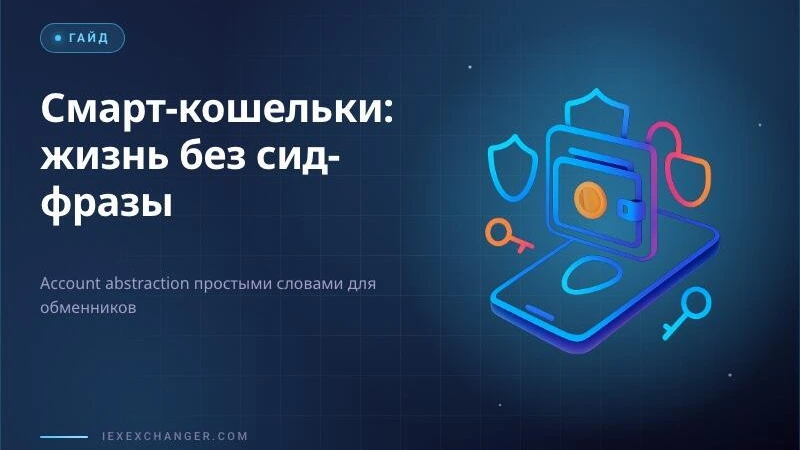
A smart wallet isn't a file holding a private key — it's a small smart contract living on the blockchain, governed by rules you set yourself. The underlying tech is called account abstraction (on Ethereum, the standard is ERC-4337), and the core idea is simple: instead of one single point of failure — the seed phrase — several independent checks confirm access at once.
Think of a bank card you could configure yourself: who can approve a payment if you lose your phone, what daily amount clears without a second confirmation, which currency covers the transfer fee. That's roughly what a smart wallet looks like for an exchanger's customer — minus the bank.
How it differs from a regular wallet
The real difference is who absorbs the damage when someone makes a mistake. In a regular wallet (an EOA, externally owned account), a lost seed phrase means the funds are gone — permanently, no exceptions.
- Recovery: a regular wallet has only the seed phrase; a smart wallet can use trusted contacts, device biometrics, or a threshold of several keys.
- Fees: a regular wallet needs the network's native coin (ETH, TRX, and so on); a smart wallet can pay fees in USDT through a paymaster.
- Batching: a regular wallet signs one transaction at a time; a smart wallet can bundle several actions into a single confirmation.
- Limits: a regular wallet has no concept of limits at all; a smart wallet can enforce a daily cap that skips extra confirmation, with a stricter threshold above it.
Who this is actually for
Smart wallets matter most where an ordinary person's mistake costs more than the technology itself. That's exactly the profile of an exchanger's customer base: most of them aren't cryptographers, but nearly all of them have felt that jolt of panic at the words "invalid seed phrase."
It pays off for the exchanger owner directly, too. A real slice of support tickets is just people locked out of their wallet — not questions about rates or fees. Remove that one cause, and your team spends its time on actual customers instead of account recovery.
How it works under the hood
There's no magic here — just three roles working together. The user signs an intent ("send 100 USDT"), a bundler packages these intents and submits them to the network, and a paymaster decides who covers the gas fee: the user, the exchanger, or a third party by arrangement.
Social recovery in this setup isn't "hand your money to friends" — it's a mathematical rule. Changing the key might require approval from two out of three pre-chosen devices or contacts. Lost your phone? There's a second factor. Lost both? Freeze withdrawals and switch to the backup.
Limitations and risks
To be blunt: a smart wallet isn't free and isn't a cure-all. Every extra rule is another smart contract call, which means more gas than a bare transaction from a regular wallet.
Not all infrastructure is equally mature. On Ethereum and the bigger L2s, the bundler/paymaster stack is battle-tested; on less popular networks, support might not exist at all. And if an exchanger's paymaster goes down temporarily, a customer could be stuck unable to cover the fee — always keep a fallback path to pay gas in the native coin.
Common mistakes when switching
The most common mistake is setting up social recovery with a single trusted contact. If there's only one, you haven't removed the single point of failure — you've just renamed it.
- Setting the auto-approve daily limit too high "for convenience" — at which point it isn't really a limit.
- Never testing the recovery flow ahead of time — better to find out it's broken now than during an actual lockout.
- Skimping on paymaster infrastructure and leaving customers with exactly one way to cover fees.
Conclusion
Smart wallets don't replace basic crypto literacy, but they take away a chunk of the risk that used to mean losing everything over one mistake. For an exchanger, that's a concrete metric: fewer "I lost access" tickets, more customers who stick around.
If you're weighing your own wallet for exchanger customers — no middleman fee, flexible recovery rules — take a look at iEXWallet.