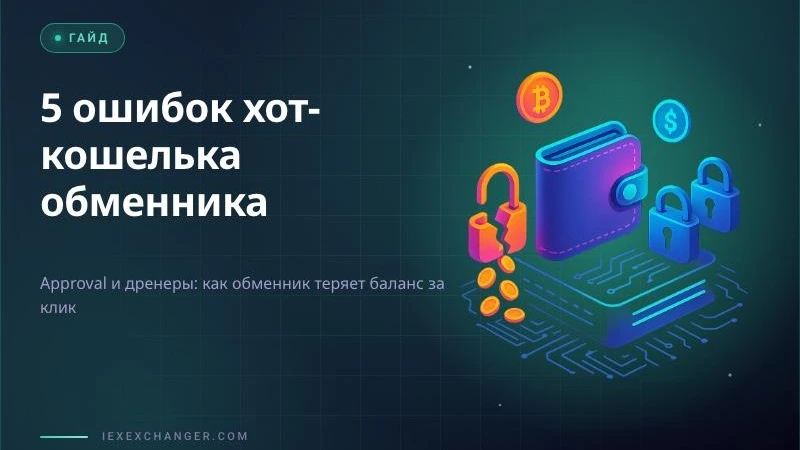
Hot wallet security isn't about antivirus software or a longer password — it's daily discipline on every transaction an exchanger sends. A hot wallet stays connected around the clock to pay clients fast, which also means it's always exposed to drainers and phishing approvals. Here are five mistakes that turn a working tool into a hole in your balance, and what to do instead.
One Address Doing Everything
The most common mistake: the same wallet receives client payments, holds working capital, and pays gas fees. Compromise that one address, and you don't lose "a bit of gas money" — you lose your entire operating float in one shot.
Picture a small exchanger keeping 40,000 USDT on a single address for incoming payments, payouts, and transfers to an exchange. One phishing site, one signed transaction, and the operator wakes up to an empty balance instead of an overnight report.
Split the roles: one address for client deposits, a separate one for payouts with a tight limit, and cold storage for the reserve. If one address is compromised, the damage is capped at whatever sits on it.
Token Approvals Nobody Ever Revokes
An approval lets a smart contract pull tokens from your address later without asking again. Handy for DEXs and bridges — but every approval is a door that doesn't close on its own.
An exchanger connects its wallet to a rate aggregator, a test bridge, a service that quietly shut down — and grants a large or unlimited approval each time. Six months later the address is linked to a dozen contracts nobody remembers. If just one gets hacked, or was malicious from day one, a drainer can pull tokens without a single signature from you at the moment of the attack.
Check active approvals monthly on a block explorer and revoke anything not in active use. Five minutes of work against the risk of losing the whole balance in one transaction.
No Limits or Alerts on Large Transfers
Without limits or notifications, a large unauthorized transfer can go unnoticed for hours — sometimes until the morning reconciliation. For a business moving client money, that delay is unacceptable.
Simple rule: any transaction above a set threshold needs a second signature, or at minimum an instant push alert to someone responsible. Multisig on payouts and real-time alerts aren't luxuries for big players — they're basic hygiene for any exchanger paying out around the clock.
Private Keys Sitting in Team Chats
Keys and seed phrases dropped into Telegram, a shared CRM note, or a Google Doc are a breach that just hasn't happened yet. Access isn't limited to the current team — it extends to everyone ever added to that chat, plus anyone who compromises one of their accounts.
Hot wallet keys belong in a secrets manager or a hardware module with restricted access — not in a conversation that's one screenshot away from leaking.
No Real-Time Wallet Monitoring
If someone checks the balance once a day by hand, an attack is discovered after the fact — once the funds are already out and mixed. Real-time monitoring is a script or service watching balance and outgoing transfers that fires an alert in seconds, not a morning report.
Even a basic bot posting to a Telegram channel on any outgoing transfer above a threshold cuts reaction time from hours to minutes.
Conclusion
An exchanger's hot wallet isn't vulnerable because the technology is weak — it's vulnerable because it gets treated like a personal wallet instead of a business till. Splitting roles, clearing out stale approvals, setting limits and alerts, and storing keys properly closes most real-world attacks. If you'd rather not build that protection from scratch, iEXWallet gives you a managed wallet built for exchangers, with no middleman fee.