A multisig wallet doesn't rely on one key — it needs several signatures before a transaction goes through, following an "M-of-N" rule: say, two approvals out of three possible keys. Sounds like red tape, but for any business running a hot wallet, it's often the only thing standing between one hacked laptop and an empty balance. Here's who actually needs it, and who it just slows down.
How a Multisig Wallet Actually Works
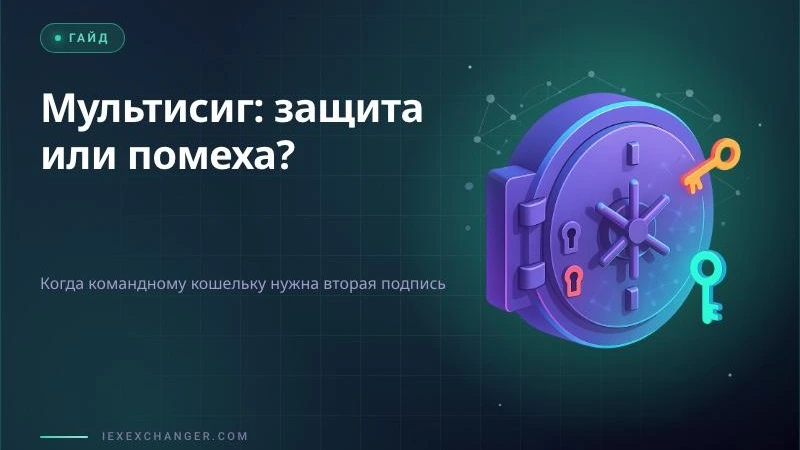
Technically, a multisig wallet is a contract or wallet scheme that demands several independent signatures for one transaction, rather than storing copies of a single key. Think of a bank's safe-deposit box that only opens when two different employees turn their keys at the same time — bribing just one of them gets you nowhere.
Picture an exchanger business keeping $100,000 in USDT on a hot wallet for fast client payouts. Without multisig, access effectively lives on one operator's laptop — compromise that machine, and the whole balance is gone in a single signature. With a 2-of-3 setup, an attacker needs to compromise two independent devices at once, which is a very different kind of attack.
Who Actually Needs a Multisig Wallet
Multisig earns its keep when several people, not one person, are responsible for the money.
- an exchanger team sharing a hot wallet for client payouts;
- a DAO or project treasury managed by more than one person;
- a shared crypto business account with multiple accountable owners;
- reserves that get spent regularly, not just parked for years.
If you're the sole owner of personal savings, a plain cold wallet with a seed phrase kept somewhere safe is usually simpler and just as solid — multisig adds its own failure points. What happens if two of your three signers are traveling at once, right when you need to move funds fast?
Multisig vs. MPC: What's the Real Difference
MPC (multi-party computation) also splits control of a wallet, but mathematically: no single party ever holds a complete key, and the signature is produced jointly without visible separate shares. Multisig, by contrast, is a set of distinct keys and distinct signatures you can actually see on-chain.
- multisig is transparent — any partner can verify on-chain that the right number of signatures was collected, though the fee is sometimes higher because of multiple signatures;
- MPC produces one final signature and is usually cheaper on gas, but it leans on a provider's closed-source cryptography, which makes outside auditing harder;
- for an exchanger that wants to show partners a transparent control scheme, multisig is often easier to explain; for a product serving a mass of everyday users, MPC tends to scale better.
Common Mistakes When Setting Up a Multisig
The scheme only protects you if it wasn't set up just for show.
- all signing devices sit physically in one office, or with one person — at that point multisig quietly becomes a single key again;
- there's no plan for when a signer leaves the company or loses a device — key rotation needs a process written down in advance, not improvised mid-panic;
- the signing threshold is picked for appearances, like 1-of-2, which offers no real protection at all;
- the wallet or contract in use hasn't been updated or independently audited in a long time.
Limits and Risks: When Multisig Isn't the Right Fit
Multisig isn't a universal fix, and admitting that matters more than selling it as one. Transactions get slower — someone has to physically collect the required signatures rather than just clicking send. If most signers live in the same jurisdiction, a disruption there — a frozen account, visa trouble, someone suddenly unreachable — can lock up the whole balance at the worst moment. Smart-contract multisig on some networks is vulnerable not just to human error but to bugs in the contract code itself. And for small day-to-day spending — hosting bills, minor client refunds — multisig just becomes friction; a separate wallet with a capped balance makes more sense there.
Conclusion
Multisig isn't a checkbox that says "we're secure" — it's a tool built for one specific threat: one device or one person getting compromised. It earns its place on a hot wallet with team access, and it's overkill for personal savings under a single signature. If you're running payouts for an exchanger and already wondering who should hold that second key, it's worth looking at ready-made infrastructure before building the scheme by hand: iEXWallet was built from the ground up for running an exchanger's wallet without an extra middleman.