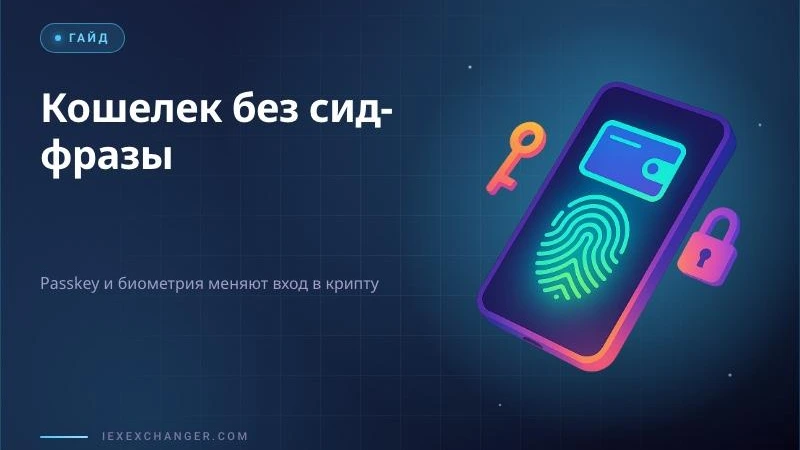
A passwordless crypto wallet sounds like it breaks crypto's golden rule, but that's exactly the pitch of passkey wallets: unlock with your fingerprint or face instead of a sheet of paper with twelve random words. For a newcomer, that's the difference between "terrifying" and "just like my banking app."
What Is a Passkey Wallet
A passkey wallet is a crypto wallet that checks who you are through your phone's own sensor — Face ID, a fingerprint, or a screen passcode — instead of a handwritten 12-to-24-word phrase. Under the hood it rides on the same passkey standard that already protects logins for email and banking apps, just pointed at a blockchain account.
Think of the difference between a bank vault and a home safe whose combination is written on a sticky note. A passkey keeps the key locked inside your device's secure chip — you can't copy it onto paper, and you can't accidentally screenshot it into your photo gallery.
What's Actually Happening Behind the Screen
Under the "no seed phrase" label, you'll usually find one of two setups. The first is a smart contract wallet (account abstraction), where a contract's logic — not a classic private key — verifies your passkey before approving a transaction. The second is an MPC wallet, where the key is mathematically split between your device and the provider's server, so neither side ever holds the whole thing.
Either way, the seed phrase doesn't vanish — it's just tucked further out of sight, and usually isn't handed to you in plain text the moment you sign up.
Who Actually Benefits
Mostly, people who've already lost access to a wallet because of a misplaced piece of paper — or who never started because that risk scared them off. For that user, a passkey wallet drops the entry barrier close to zero.
Experienced holders moving serious amounts, who want full self-custody and a multisig split across several keys, usually gain a dependency on one provider rather than freedom.
What to Check Before You Pick One
- Whether you can export a full private key or seed phrase at any time — a provider worth trusting allows this;
- What the recovery model looks like if your device is lost: a second trusted device, email, trusted contacts;
- Whether the smart contract has been independently audited and the code published;
- Whether it supports the networks and tokens you actually use, not just one ecosystem.
Limits and Risks
A passkey protects you from forgetting a phrase — not from everything else. If the MPC provider's server is compromised, or the Apple or Google account syncing your passkey gets hijacked, your wallet access is suddenly at risk too, and that's outside your own control.
Plenty of dApps and exchanges still can't work with these wallets directly, so for some operations you'll end up exporting a classic key anyway.
Common Mistakes
The most common one: relying on a single recovery method and never setting up a backup. The second: picking a wallet that doesn't let you export a key at all, leaving you fully locked into one service.
Conclusion
Passkey wallets don't cancel the basic rules of crypto security — they just change the shape those rules take. As a starting point, they're a genuinely comfortable way to try crypto without the fear of losing a 24-word phrase. If you run your own exchanger, you can offer clients a clean, transparent wallet through iEXWallet — without paying a middleman's cut.