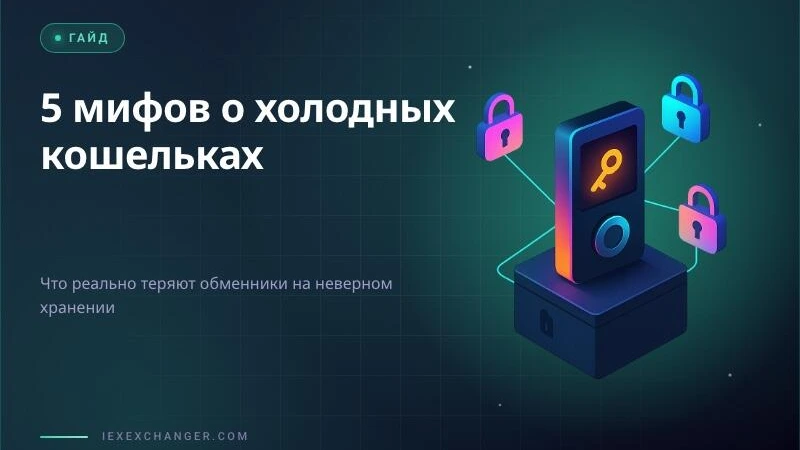
A cold wallet for an exchanger is a way to hold private keys somewhere no one can steal them remotely: a hardware device, an air-gapped machine that has never touched the internet, or a multisig setup where keys are physically split across people and devices. It sounds like a solved problem. In practice, cold storage has picked up enough myths that exchanger owners routinely make the wrong call — and pay for it in either cash or downtime.
What "cold storage" actually covers
The same word hides very different setups, and that's worth untangling first. A $100 hardware wallet, a laptop that has never seen Wi-Fi, and an enterprise-grade HSM module are all technically "cold storage." But they differ in reliability, cost and convenience about as much as a bicycle differs from a delivery truck.
A small exchanger with a modest reserve can get by on a couple of hardware wallets plus multisig. A platform moving serious volume is a different conversation — dedicated HSM hardware, an access policy, physical security. Mixing up these tiers is where half the trouble below actually starts.
Myth 1: going offline protects you from every mistake
It doesn't. Offline storage removes exactly one risk — remote hacking over the internet. Human error stays fully in play: a seed phrase copied down wrong, a transaction signed without reading it, a lost device with no backup anywhere.
A telling scenario: an employee tasked with setting up the cold wallet photographed the seed phrase on their phone "just to be safe" — and the phone synced straight to the cloud. Technically, the keys never touched the internet directly. Practically, they leaked on day one.
Myth 2: crypto in cold storage is "frozen" and slows the business down
That's backwards — and it's exactly how many exchangers lose money for nothing, keeping too much in the hot wallet "for speed." A sane setup is a balance: the hot wallet holds only what's needed for the next few hours of customer payouts, while the bulk of the reserve sits in cold storage and tops the hot wallet up on a schedule.
- A hot wallet is a working buffer, not a reserve vault.
- Moving funds from cold to hot takes minutes once the procedure is rehearsed.
- Demand spikes get absorbed by top-up speed, not by hot wallet size.
An exchanger keeping 80% of its reserve hot "for convenience" isn't moving faster — it's just exposing most of its money to risk to save a few minutes on transfers.
Myth 3: one seed for the whole reserve is good enough
A single key set is a single point of failure, no matter how cleverly the paper backup is hidden. Lose the device and the backup together, and everything is gone. Snap a photo of the seed phrase into a messenger app, and the outcome is the same.
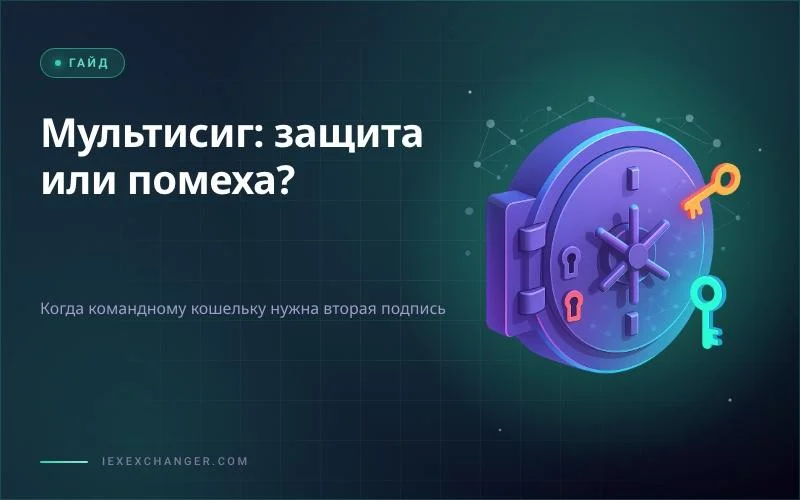
Multisig works like a safe with two locks that open with different keys held by different people: signing a transaction needs, say, 2 of 3 possible signatures. Losing one key doesn't lock you out of your own funds, and it doesn't let one bad actor walk away with them either.
How to size a cold storage setup to your actual scale
There's no universal answer — the setup should grow with the exchanger, not run three steps ahead of it.
What to weigh
- Reserve size, and what share of it genuinely needs to stay "hot."
- How many people can sign, and what happens if one of them is suddenly unreachable.
- How fast the hot wallet gets topped up during peak hours.
- Whether there's a written plan for a lost device or a compromised key.
- Logging and audit trails — who signed what, and when.
If those questions don't have clear answers, the storage setup isn't protection — it's a well-organized accident waiting to happen.
When cold storage is overkill
Honestly: not every exchanger needs a full multisig-plus-HSM setup on day one. If the team is two people and the reserve is modest, a complex scheme with several key holders can add more risk than it removes — it just complicates an already thin process, and the bus-factor problem doesn't disappear, it just moves into the hardware.
Early on, it's often smarter to lean on a managed solution with clear accountability, then grow custody infrastructure in-house as volume actually justifies it — rather than building a complex system nobody on the team can maintain.
Common mistakes when switching to cold storage
Even a sound setup on paper gets undone by details in practice.
- Moving a large sum on the very first transfer, skipping a small test transaction.
- Storing every seed phrase backup in the same place as the device itself.
- No written plan for when a key holder is on leave, sick, or has left the company.
- Flashing device firmware from whatever source is handy, without verifying it against the official one.
Each mistake looks minor on its own. Together, they turn cold storage from protection into a risk that just surfaces less often.
Conclusion
A cold wallet isn't a magic "now it's safe" button — it's a tool that only works with a deliberate access scheme, backup plan and hot-wallet top-up policy behind it. Figuring all that out from scratch is not a one-evening task, especially while also launching the exchanger itself. For those building their own exchanger who want custody handled without improvisation, iEXWallet already builds that storage logic in, with no middleman fee.