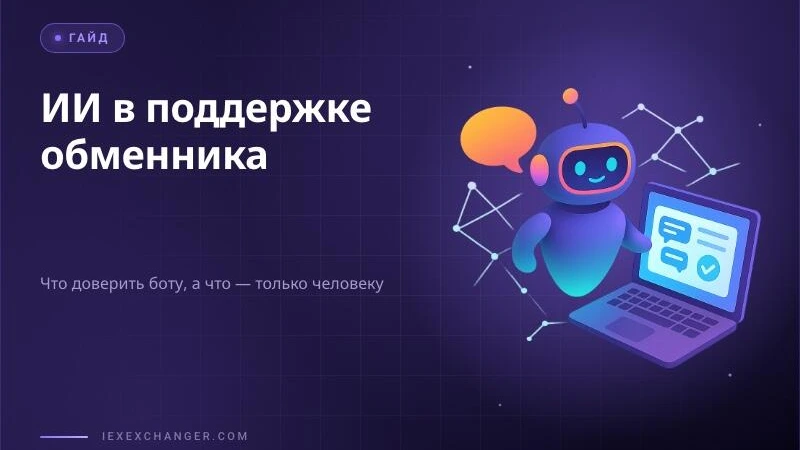
An AI support bot can already resolve a third of a crypto exchanger's tickets faster than a human agent — rate checks, verification status, where's-my-money questions. But some tickets should never reach a bot alone, and owners need to know exactly where that line sits before handing support over to an algorithm.
What AI Can Close Without a Human
Routine questions. More than half of the messages hitting a crypto exchanger's support inbox are the same five or six questions, and a bot handles them at least as well as a live agent — often faster.
- Current rate and limits for a specific exchange direction
- Order status — processing, waiting for network confirmation, completed
- Which documents verification needs, and why it's being asked for again
- A step-by-step walkthrough on how to send crypto to the exchanger's wallet, aimed at first-timers
- A reminder that the network fee isn't something the exchanger controls
The customer gets an answer in seconds, and the agent is freed up for the conversations that actually need a human brain.
Where AI Trips Up — A Real-World Scenario
It's 3 a.m. and a customer says they sent 500 USDT an hour ago and it still hasn't shown up — this is exactly the moment a templated bot reply can cost an exchanger its reputation.
The bot will probably blame network congestion, and half the time it'll be right. But sometimes the real cause is different: the customer picked the wrong network, TRC-20 instead of ERC-20, or mistyped one character of the address. Pulling up the transaction hash on a block explorer, matching it to the order, and judging whether something looks off — that's not a call AI can make on its own.
In cases like this the bot shouldn't guess — it should escalate instantly to a live agent, with the full chat history attached, not a blank slate.
Rolling Out AI Support Without Losing Customers
The rollout works if you resist the urge to automate everything on day one.
- Start with the three or four most common questions and train the bot only on those
- Write explicit escalation triggers: amounts above a threshold, the phrase hasn't arrived, repeat contact
- Keep a visible talk-to-a-human button at every step of the conversation
- Review the bot's failed conversations weekly and expand its knowledge base
That way the bot grows alongside what customers actually ask, not an abstract plan.
Mistakes First-Time Exchanger Owners Make
The problem is rarely the AI itself — it's how it gets rolled out.
- Letting the bot rule on disputed transactions instead of escalating them
- Switching off human coverage entirely overnight, exactly when things tend to go wrong
- Launching the bot without testing it on real tickets from support history first
- Forgetting to update the knowledge base after fees or verification rules change
Conclusion
AI support is an accelerator, not a replacement for your team — it clears out the routine so your agents are left with exactly the conversations that need a human. If you're building out support for your own exchanger, a ready-made chat with flexible escalation rules is easier to plug in than building one from scratch — iEXChat from iEXExchanger is one option.